Swiss medicine is associated with precision, advanced technology and a personal approach to every patient. Yet the reputation of its clinics rests on more than buildings, equipment and service. The system’s greatest asset is its doctors: professors at university hospitals, highly specialised consultants at private clinics, surgeons with international practices, and researchers who treat patients while helping to develop new therapies.
Switzerland has no single official list of the best doctors. There are professional registers, university appointments, scientific publications, clinical experience, membership of specialist societies, recognition among peers and patient feedback. The right question, therefore, is “which specialist is best suited to my diagnosis?” rather than “who is the most famous doctor?”.
Swiss medicine: why the standard of doctors is so high
According to FMH, the Swiss Medical Association, 42,602 doctors were working in the country in 2024. Physician density stood at 4.1 full-time equivalents per 1,000 inhabitants. This is comparable with neighbouring European countries, but what matters more is this: a large proportion of specialists pass through a rigorous system of training, specialisation and continuing education.
Switzerland regulates the profession through both state and professional mechanisms. In MedReg, the federal register of medical professions, you can verify a doctor’s diploma, specialisation, languages and licence to practise independently. For patients this is an important safeguard: a doctor should be an officially registered specialist, and reputation alone is not enough.
Continuing education is another element of quality. Swiss medical societies state that Continuous Medical Education (CME) is mandatory for doctors holding a federal or recognised postgraduate title for as long as they practise. In a patient’s terms, this means that a good doctor keeps learning long after university and regularly confirms their competence.
“A doctor in Switzerland is a clinician and, at the same time, part of a system of quality control: registration, specialisation, ongoing training and work within a professional community.”
What makes a leading doctor in Switzerland
The profile of a leading specialist is usually built on several characteristics:
- relevant education and a recognised specialisation;
- 15–30 years of practice in a specific field;
- work at a university hospital or a strong private centre;
- participation in tumour boards and international societies;
- scientific publications and conferences;
- experience with complex operations or rare cases;
- command of several languages;
- the ability to explain a diagnosis and the treatment options to the patient.
For an international patient, two factors matter most: narrow specialisation and communication. A doctor may be a brilliant surgeon and still be the wrong choice for a particular case if their experience lies with a different condition. “Orthopaedic surgeon”, for example, is too broad a term: one specialist focuses on the shoulder, another on knee replacement, a third on sports injuries and a fourth on the spine.
Professors and clinicians: what is the difference
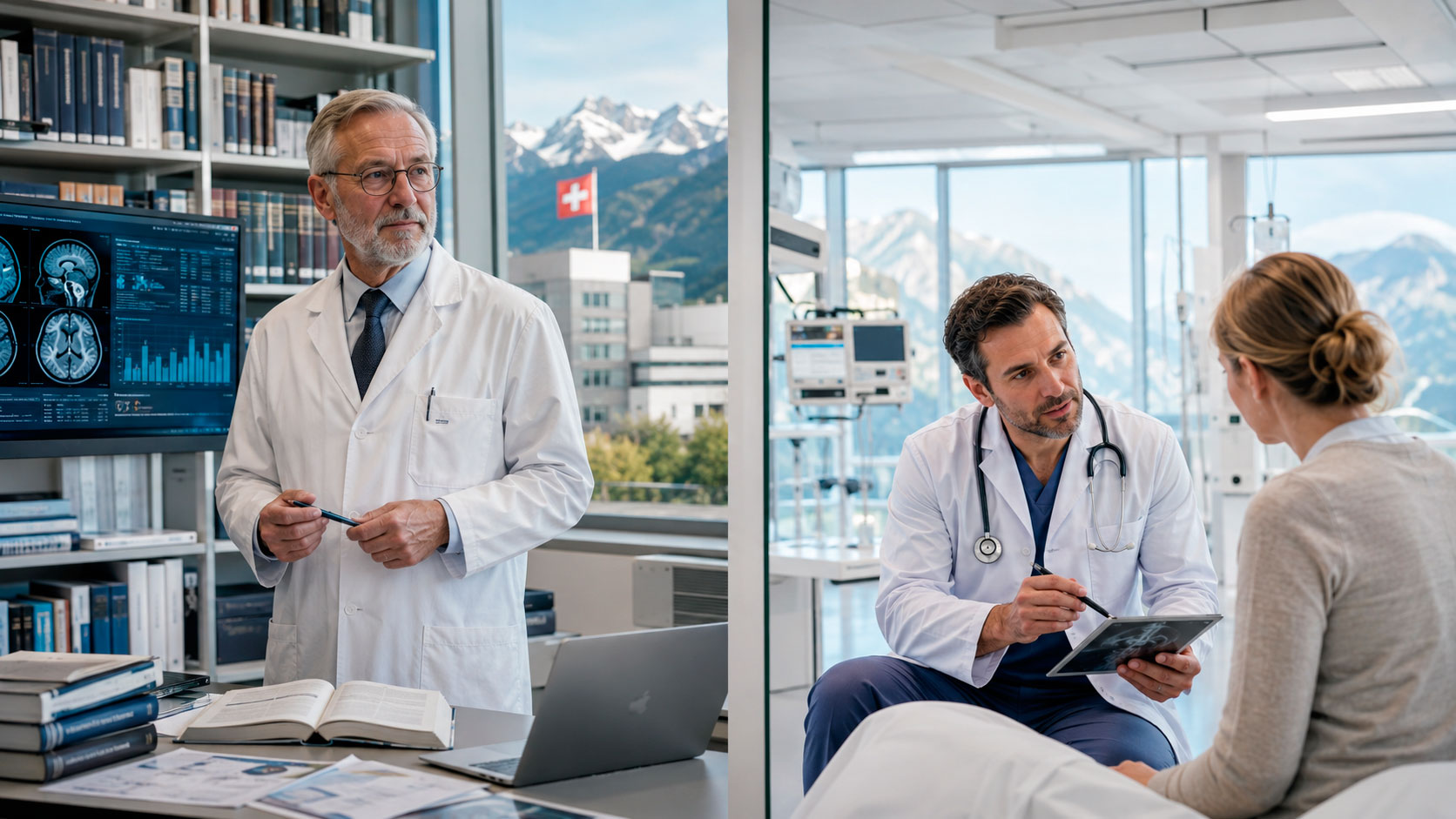
In Swiss medicine you will often see the titles Prof. Dr. med., PD Dr. med. and Dr. med. They are important, but they should not be the only criterion for your choice.
A professor usually combines clinical practice, teaching and research. Such a doctor is especially valuable for complex diagnoses, when access to university expertise, a multidisciplinary tumour board and current protocols is needed. For a planned operation, however, the number of such procedures the surgeon has performed in recent years can matter more than a professorial title.
Good medical matching therefore always looks at the whole combination: doctor + diagnosis + clinic + technology + team.
Examples of renowned specialists by field
What follows is a set of reference points rather than an “absolute ranking”: doctors and professors who represent different facets of the Swiss school of medicine.
Prof. Boris Tutschek – prenatal diagnosis and maternal-fetal medicine
Professor Boris Tutschek specialises in prenatal diagnosis, maternal-fetal medicine and the management of high-risk pregnancies. For more than 20 years he has performed expert ultrasound examinations and handled complex obstetric cases. He is one of Europe’s leading specialists in his field and works at Privatklinik Bethanien in Zurich.
Dr. Jörg Obwegeser – specialist in operative gynaecology and obstetrics
Dr. Jörg Obwegeser is a leading specialist in operative gynaecology and obstetrics with more than 30 years of experience, focusing on the diagnosis and treatment of women’s diseases. In his practice he uses modern surgical technologies and an individual approach to every patient.
Dr. Walter Weder – thoracic surgery
Professor Walter Weder specialises in thoracic surgery and the treatment of diseases of the lungs and chest organs. He is known for the high level of his surgical expertise and his many years of work at leading Swiss medical centres. His professional achievements have made his name known far beyond Switzerland.
Prof. Patrick Imesch – gynaecological oncology
Dr. Patrick Imesch works in gynaecological oncology and the surgical treatment of diseases of the female reproductive system. He provides comprehensive diagnosis and treatment of cancer, using modern therapies and minimally invasive techniques. He places particular emphasis on personalised care for his patients.
Dr. Michael Fischer – specialist in neurostimulation
Dr. Michael Fischer is a leading specialist in neurostimulation with more than 20 years of experience, applying advanced methods to treat psychiatric and neurological disorders. In his practice he uses modern methods to restore function and helps patients return to an active life.
Prof. Claudia Kell – gynaecology
Dr. Claudia Kell focuses on women’s health and on the prevention and treatment of gynaecological conditions. She advises patients on reproductive medicine and modern treatment methods. Her professional experience and attentive approach have earned her the trust of patients from many countries.
Prof. Lea Köchli – specialist in gynaecology and obstetrics
Dr. Lea Köchli is a specialist in gynaecology and obstetrics with more than 15 years of experience, offering professional care in all areas of women’s health. In her work she places the emphasis on precise diagnosis and on choosing the optimal treatment strategy.
Prof. Monika Jermann – oncology and haematology
Prof. Monika Jermann is a leading specialist in medical oncology and haematology with more than 20 years of experience, offering advanced treatments for cancer and blood disorders. Her extensive practical experience enables her to work effectively on complex oncological and haematological cases.
In addition to the specialists listed here, CorSwiss works with other highly qualified doctors across a range of medical fields. You can find all our specialists, their experience and areas of expertise in the Doctors section.
Historical figures: why they are worth remembering
The Swiss medical tradition has taken shape over centuries. Among the historical names most often mentioned is Paracelsus, a 16th-century physician and thinker who influenced the development of toxicology and pharmacology. Carl Gustav Jung became one of the key figures of 20th-century psychiatry and psychology. These names have no bearing on choosing a doctor today, but they illustrate the cultural background: in Switzerland, medicine, science and an individual approach to the person have long been closely linked.
Where the leading doctors work
Strong specialists are most often found in three types of institution.
- University hospitals: University Hospital Zurich, CHUV Lausanne, Universitätsspital Basel, HUG Geneva. Their strengths are complex cases, oncology, transplant medicine, neurosurgery, cardiology and rare diseases.
- Private clinics: Swiss Medical Network, Clinique Générale-Beaulieu, Privatklinik Bethanien. Here patients enjoy a higher level of service, flexible scheduling, individual arrangements and access to specialists in private practice.
- Rehabilitation and specialist centres: Davos, Valmont, cereneo, and clinics for neurological and pulmonary rehabilitation. Here the whole team matters alongside the doctors: physiotherapists, neuropsychologists, speech therapists and rehabilitation specialists.
How to find the right doctor
In practice, the process looks like this:
- Establish the exact diagnosis or medical question.
- Gather medical reports, imaging, test results and your treatment history.
- Choose 2–3 clinics that are strong in the relevant field.
- Check the doctor in MedReg and on the clinic’s official website.
- Review their specialisation, publications and surgical experience.
- Request an online consultation or a second opinion.
- Obtain a treatment plan and a detailed cost estimate.
- Compare the doctor, technology, timing and rehabilitation as well as the price.
Common mistakes when choosing a doctor
Patients often go wrong in four areas.
- The first mistake is choosing by a big name. A renowned professor may not be the best option if their field does not match the diagnosis.
- The second is relying on aggregators without checking official sources. Lists of “top doctors” are a useful starting point, but the information should be verified against the clinic’s website, MedReg and professional societies.
- The third is failing to ask who exactly will perform the operation. It is important to know in advance whether the lead doctor will operate personally, assist or only advise.
- The fourth is underestimating the team. In complex oncology, cardiac surgery, neurology and rehabilitation, the outcome depends on the tumour board and the quality of follow-up care as much as on any single doctor.
Switzerland’s leading doctors are specialists who have come through a rigorous system of education, work in a transparent professional environment, continually develop their skills and often combine practice with research.
The guiding principle of the choice is to look for the doctor best suited to the specific diagnosis rather than the most famous one. Switzerland’s particular strength is personalised medicine: the right clinic, the right specialist, precise diagnostics, a clear treatment plan and a team approach. This is what turns a medical journey into a predictable path rather than a guess based on a ranking.
Frequently asked questions
Are there doctors in Switzerland who speak my language?
Yes, although patients are more often provided with a medical interpreter. It is more reliable to choose a doctor by specialisation and to resolve the language question through the clinic’s international department.
Can I get a second opinion online?
Yes. Many clinics review documents remotely and give a preliminary opinion, provided the medical file is sufficiently complete.
How can I tell whether a doctor is truly qualified?
Check MedReg, the clinic’s official page, the FMH specialist title, publications, experience with the specific diagnosis and membership of specialist societies.
Is a professor always better than a regular doctor?
Not always. A professor is important for complex and rare cases. For a standard planned operation, the surgeon’s practical experience with the specific technique may be the decisive factor.