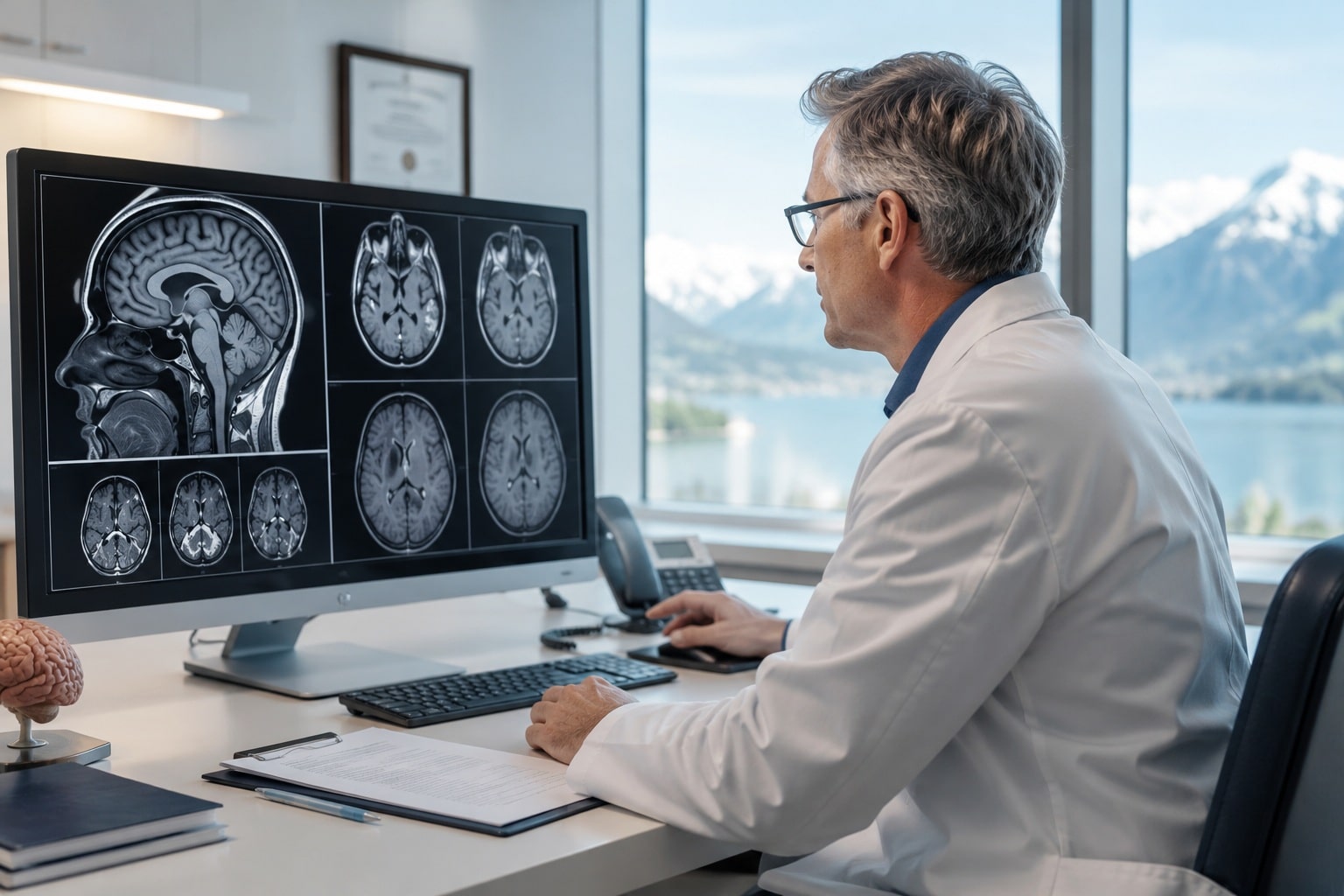
A second opinion is a review of your diagnosis and treatment plan by another specialist in the same field, based on your medical records. People usually seek one at a turning point: a serious diagnosis, a proposed operation, or treatment that is not working as expected.
This article explains when a second opinion is genuinely useful and when you should not wait for one, why patients turn to Swiss specialists, how to obtain an opinion remotely, which documents to gather and what to do if the doctors disagree.
What a second opinion is — and what it is not
The second specialist studies the same information on which the diagnosis is based: reports, test results, scans and, where needed, histology slides, that is, thin sections of tissue examined under a microscope. They then give a written opinion. They may agree with the diagnosis and treatment plan, refine them or suggest a different approach.
A second opinion is not a test of your doctor, nor a complaint about them. A guide to patients’ rights published jointly by eight Swiss cantons puts it plainly: seeking a second opinion is not a vote of no confidence in the professional treating you. It gives you more information and helps you decide, in full knowledge of the facts, whether to agree to treatment.
In Switzerland, this is an established part of care. University hospitals handle such requests as a standard service, and the cancer centre at University Hospital Zurich accepts them even from people who are not its patients.
A second opinion does not replace your own doctor: a specialist reviewing records does not examine you or take over your care. You still make decisions together with your treating doctor.
Sometimes the opinion comes from a team rather than one specialist. In oncology, this is the tumour board: a regular meeting of surgeons, oncologists, radiation oncologists, radiologists, pathologists and other specialists who agree a treatment plan together.
When a second opinion is genuinely needed
A second opinion is particularly useful in these situations:
- A serious diagnosis. Cancer, serious heart disease or a disorder of the nervous system: the stakes are high, and the diagnosis has to be right.
- Surgery or irreversible treatment is proposed. The Swiss patients’ rights guide calls a second opinion particularly sensible when a non-urgent operation or a treatment with serious consequences is proposed.
- Treatment is not working. If the expected effect does not appear, both the diagnosis and the chosen approach deserve a second look.
- Doctors disagree, or offer several options and it is unclear how they differ.
- A rare disease. Few doctors see rare conditions regularly, so the experience of a highly specialised doctor is especially valuable.
- Doubts about imaging. An MRI or CT report is ambiguous, uses the word “suspected”, or different tests contradict each other.

When not to wait for one
If your condition needs urgent care — a suspected heart attack or stroke, bleeding, sudden severe pain — treatment comes first and discussion later. In oncology, too, some decisions have to be made straight away. The American Cancer Society (ACS) advises: if you are unsure whether you can wait, ask your treating doctor. A second opinion should never delay urgent treatment.
Why patients turn to Swiss doctors for a second opinion
Switzerland has five university hospitals: University Hospital Zurich (USZ), Inselspital in Bern, University Hospital Basel, Lausanne University Hospital (CHUV) and Geneva University Hospitals (HUG). They combine patient care, medical training and research, and bring together highly specialised doctors, including experts in complex and rare diseases.
All five run multidisciplinary tumour boards. In Zurich, they meet weekly across 17 centres, each focused on tumours of particular organs. At Inselspital, every patient of the cancer centre is discussed at a specialised tumour board. In Geneva, each type of cancer has its own board, where up to around ten doctors review a case.
So, for a second opinion, look for a specialist in your specific condition, not simply a “good clinic”.
A study by Mayo Clinic in the United States shows why it can be worth taking a complex case to a specialised centre. Researchers compared the diagnoses with which 286 patients had been referred from primary care to an academic medical centre with the final diagnoses made there. In 21% of cases the final diagnosis was distinctly different, in 66% it was refined, and in only 12% it was the same (Van Such M. et al., 2017).
These figures need careful reading. They come from one centre and concern patients referred for specialist assessment, not every second opinion. According to the ACS, studies show that the benefits of a second opinion are still unclear. Their value lies in a careful, independent review, not in a guarantee of a different answer.
How to get a second opinion remotely: 7 steps
A second opinion usually requires no travel: the specialist works with your records, image files and, if needed, histology slides. You can organise this yourself or through a medical concierge.
CorSwiss is a Swiss concierge service that organises everything end to end and works with leading Swiss doctors. The process usually looks like this.
Step 1. First conversation
You describe the situation in your own words and set out the main question: confirming the diagnosis, choosing between treatment options, or deciding whether surgery is needed. You do not need medical records for a first conversation with CorSwiss; they can follow later.
Step 2. Records
Everything on which the diagnosis is based is collected: reports, test results, scans, operation notes and histology reports. A detailed list follows below.
Step 3. Translation
Reports are translated into the language the specialist works in. The translation must be medical, with precise terminology: one wrong word can change the meaning of a report. The images themselves need no translation.
Step 4. Choosing the professor
A specialist in the relevant subspecialty is chosen for your question, sometimes more than one: a surgeon and an oncologist, for example. Every hospital has its own rules for accepting requests. Inselspital’s cancer centre, for instance, states that its services are generally available only to people with Swiss basic health insurance. So it helps to know in advance where to send a request and in what form.
Step 5. Review
The specialist studies the records. A radiologist may re-read the scans, and a pathologist (the doctor who diagnoses disease from tissue) may re-examine the slides. A complex cancer case may go to a tumour board. If information is missing, the doctor will say which tests are needed.
Step 6. Written opinion and video consultation
The result is a written opinion with conclusions and recommendations, translated into your language. Any remaining questions can be discussed with the specialist by video call. Whether this is possible depends on the doctor and the hospital, so it is best to ask in advance.
Step 7. What next
You discuss the opinion with your treating doctor. There are then two paths: treatment at home in line with the recommendations, or a trip to Switzerland. We describe how such a trip works in “How Treatment in Switzerland Is Organised: Step by Step”.
Which documents you will need: a checklist
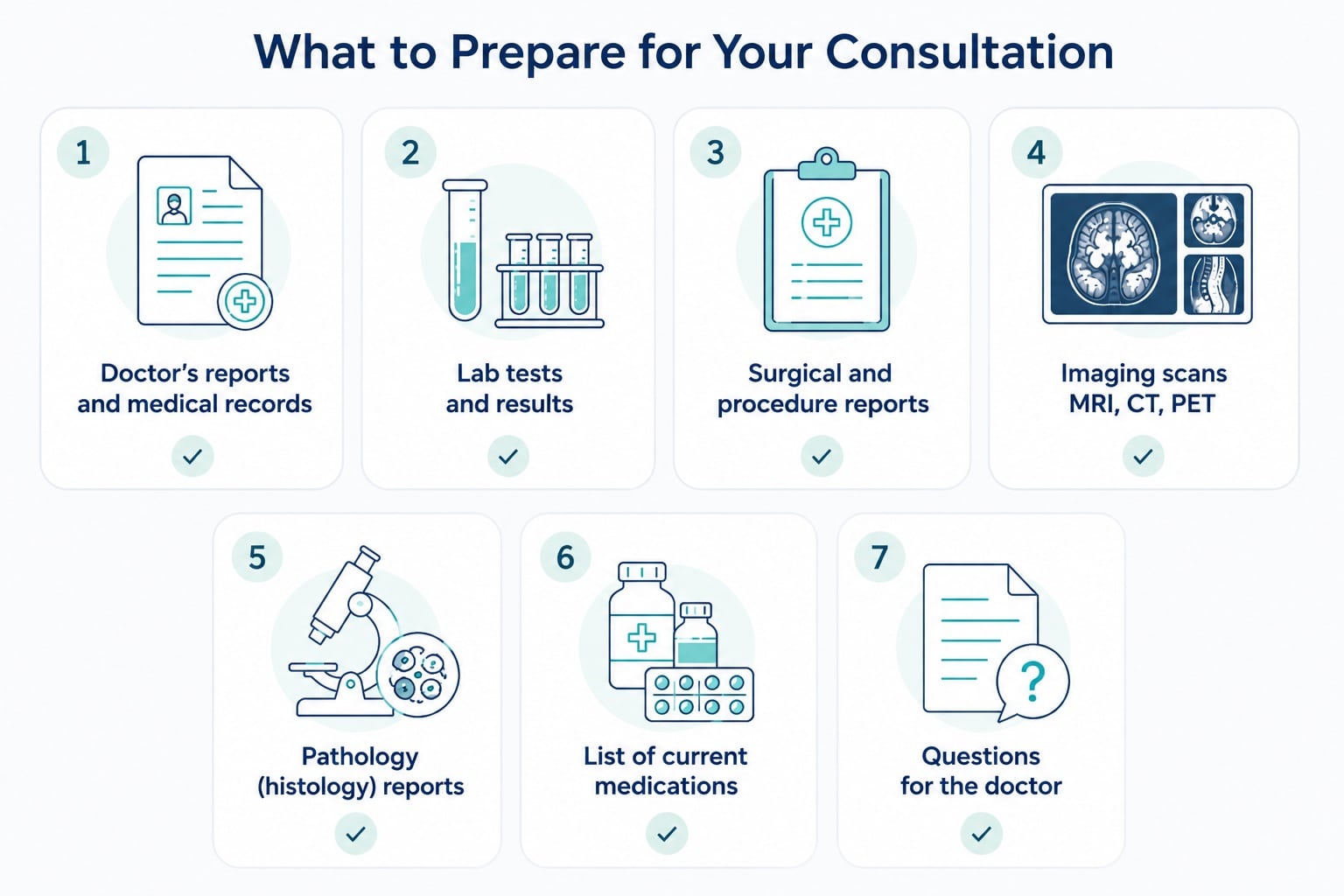
- Discharge summaries and specialist reports, ideally all of them, in chronological order.
- Test results with dates and the laboratory’s reference ranges; if the trend matters, for the whole period.
- Operation and procedure notes, including biopsies and endoscopies.
- MRI, CT and PET (positron emission tomography) scans: the files themselves in DICOM format, not just the reports. DICOM is the international standard for medical images; it keeps the data and quality needed for clinical use. Images are usually supplied on a disc or USB stick, or via a link to an archive. Add earlier scans too: comparison with previous images helps the radiologist.
- Histology: the pathologist’s report and, if a review is needed, the slides and paraffin blocks themselves.
- A list of medicines: names, doses and dates, including previous courses of treatment.
- Questions for the doctor: a few key ones, written down in advance.
A second opinion on MRI and CT scans
A review of imaging is a separate kind of second opinion. Another radiologist re-examines every series of the scan, not just the report. They may spot something that was missed, interpret a finding differently, measure a lesion more precisely or compare it with earlier scans. This matters most when a decision depends on detail: brain and spine MRI in neurology, for example, or heart and vessel imaging in cardiology.
Such a review has limits. A radiologist sees only what is on the images: if a scan was done without contrast, without the right sequences or at low quality, it may have to be repeated. Images are interpreted alongside symptoms, examination findings and test results, so reports should accompany them. Above all, a radiologist’s opinion is not a treatment plan. The decision rests with the specialist treating the condition, who weighs all the information.
A second opinion in oncology
In cancer care, treatment depends on a precise diagnosis: the type and subtype of the tumour, its stage and its molecular features. That is why a second opinion here often begins with a review of the histology.
Histology is the examination of tissue under a microscope. Tissue taken at biopsy or surgery is embedded in paraffin wax to form a block. Very thin sections are cut from it, stained and placed on glass slides. Another pathologist can review these slides and, if needed, cut new sections from the block for additional tests. The material already obtained is usually enough, so a repeat biopsy is not needed. If there is too little material, a new biopsy may be required.
Discuss the slides and blocks in advance with your treating doctor and the laboratory where they are stored. They are original material, not copies, so it is important to understand how they are released and returned.
The second element is the tumour board. In Geneva, for example, a board can review a case in response to a request for a second opinion: it examines the imaging, pathology and other information and sends a written report with its recommendations.
The outcome is a choice of strategy: whether to start with surgery or with drug therapy, whether radiotherapy is needed, whether monitoring is appropriate, and whether a suitable clinical trial exists. More on our oncology page.
What it costs and how long it takes
There is no single price or timescale for a second opinion. Both depend on several factors:
- the complexity of the case and the volume of records;
- how many specialists are involved: one professor or a tumour board;
- whether imaging and histology need review, and whether additional tests are required;
- the volume of translation, of both the records and the opinion;
- whether a video consultation with the specialist is needed.
Timing also depends on how complete the records are and how long it takes to obtain scans, slides and blocks. It is sensible to clarify cost and timing before work begins. What makes up the price of an appointment in Switzerland is explained in “The Cost of a Doctor’s Visit in Switzerland”.
If the opinions differ
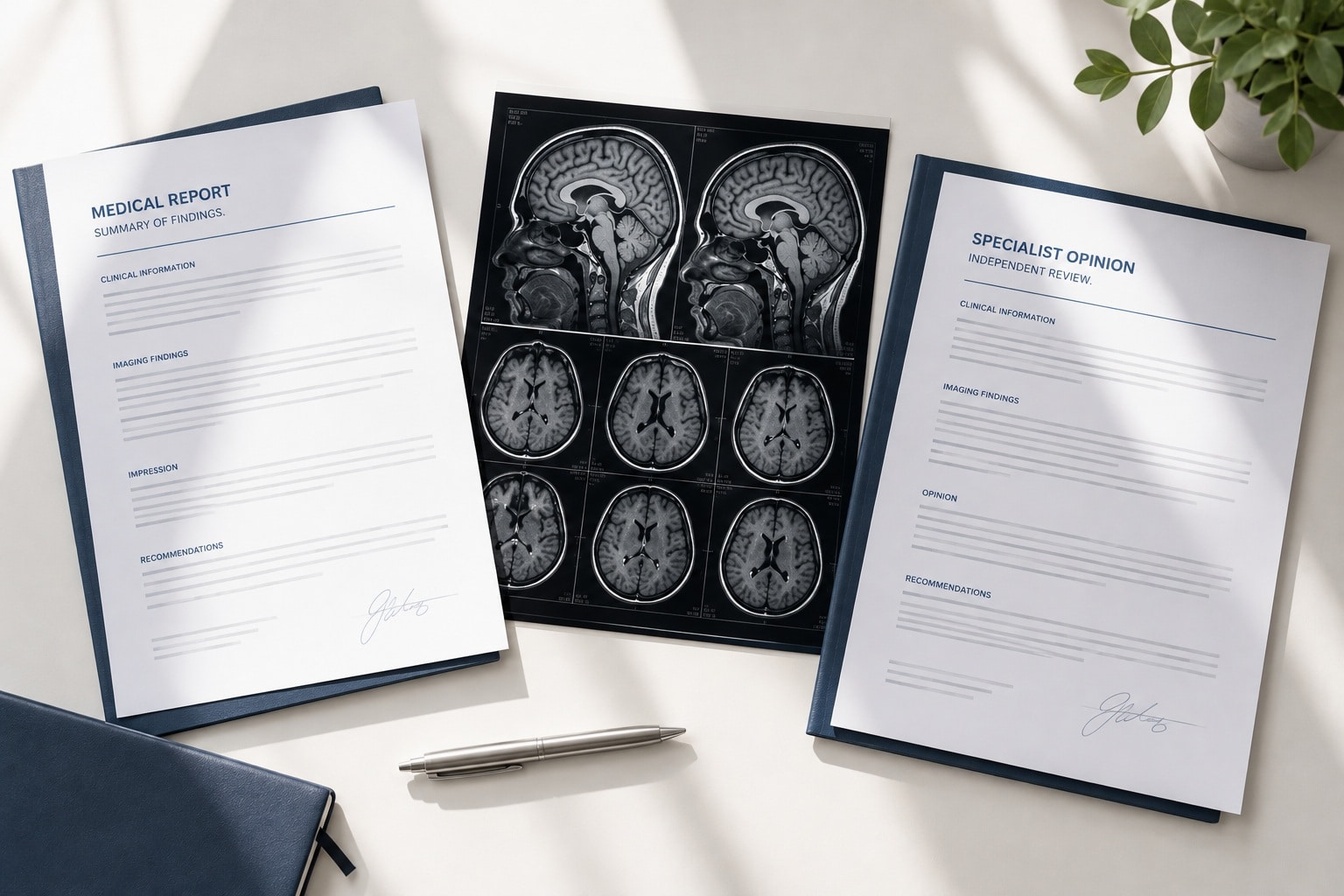
A disagreement is not a reason to panic; it is new information. Here is what you can do:
- Check the underlying data. Opinions sometimes differ because the specialists saw different material: one the scans themselves, the other only the report.
- Talk to both doctors. The ACS suggests discussing the second opinion with your first doctor and asking each doctor how they reached their conclusion and which guidelines they relied on.
- Ask for a joint discussion. The doctors may be able to review the case together.
- Seek a third opinion, or ask for the case to go to a tumour board if the question remains open.
The final decision rests with the patient. Geneva University Hospitals, for example, state it plainly: the tumour board makes a proposal, but the decision on treatment always lies with the patient, supported by their doctor.
Common mistakes
- Sending only the imaging reports. Without the DICOM files, a radiologist cannot review the scan.
- Collecting records selectively. Without earlier scans, operation notes and a list of medicines, the picture is incomplete.
- Saving on translation. An imprecise term can distort the meaning of a report.
- Looking for “the best clinic” rather than a specialist. You need a doctor who focuses on your condition.
- Delaying urgent treatment. If your doctor says you cannot wait, the second opinion can.
- Not framing the question. Without a clear question, the answer is generic and the opinion less useful.
How CorSwiss arranges a second opinion
CorSwiss is a Swiss medical concierge. Since 2011, the company has connected international guests with Switzerland’s leading clinics and professors. Second opinions are one of its services, and you can obtain one remotely, from your records, before any travel is planned.
- First conversation: confidential, in your language and without obligation; medical records can follow later.
- Choice of a specific professor, not just a clinic, for your diagnosis and question.
- A personal coordinator within reach throughout your journey.
- Translation and organisation of your records, before a trip and after your return.
- A medically experienced interpreter at every appointment if you travel to Switzerland.
- Consultations remotely, meetings in person: at the clinic, your hotel or the airport.
- Confidentiality: your data remain with CorSwiss alone.
Everything is arranged end to end, from the first conversation to the written opinion and, if needed, treatment. You can ask a question on our contacts page.
Frequently asked questions
Can I get a second opinion online, without leaving home?
Yes, in many cases. The specialist reviews records, scans and, if needed, histology remotely. Sometimes a final conclusion requires an examination or a new test, and the written opinion will say so.
Do my documents need translating?
Usually, yes: reports are translated into the language the specialist works in. Image files need no translation. The Swiss doctor’s opinion is then translated into your language.
Will my doctor mind?
Usually not. The US National Cancer Institute notes that second opinions are very common and that most doctors welcome them. It is best to tell your doctor beforehand: they can help gather your records.
What if a new test is needed?
The specialist will say which test is needed and why. It can be done at home and the results sent on, or carried out in Switzerland; you decide together with your doctor.
Can I then be treated in Switzerland?
Yes, if you choose to. A second opinion does not oblige you to be treated where it was given: Geneva University Hospitals, for example, state that a tumour board’s recommendations can be followed at another hospital. If you decide to travel, the opinion becomes the basis of your treatment programme.
How is confidentiality protected?
In Switzerland, health professionals are bound by professional (medical) secrecy: they may not share information with third parties without the patient’s consent, except where the law provides otherwise. CorSwiss also works in complete confidentiality: your data remain with CorSwiss alone.
Sources
- Van Such M., Lohr R., Beckman T., Naessens J. M. Extent of diagnostic agreement among medical referrals. Journal of Evaluation in Clinical Practice, 2017 — PubMed
- Die Patientenrechte im Überblick: patients’ rights guide of the cantons of Bern, Fribourg, Geneva, Jura, Neuchâtel, Ticino, Valais and Vaud, 2024 — PDF
- unimedsuisse, the association of Swiss university hospitals and medical faculties — unimedsuisse.ch
- Tumour boards and second opinions: USZ, Inselspital, University Hospital Basel, CHUV, HUG
- Inselspital, University Comprehensive Cancer Center: Referral & Second Opinion — tumorzentrum.insel.ch
- National Cancer Institute: Pathology Reports — cancer.gov
- National Cancer Institute: Finding Cancer Care — cancer.gov
- American Cancer Society: Seeking a Second Opinion — cancer.org
- DICOM Standard: About DICOM — dicomstandard.org
- RadiologyInfo.org (RSNA, ACR): Your Radiology Report — radiologyinfo.org


