Medical tourism means travelling to another country for diagnostics, treatment or rehabilitation. People travel for a particular doctor, a particular treatment or more precise diagnostics. Yet the final cost of the trip is not just the clinic’s bill: repeat tests, postponed dates, extra hotel nights and changed flights all add to it.
Below are ten mistakes that most often make treatment abroad more expensive and slower. They follow the order of the patient’s journey, from choosing a doctor to returning home. For each one, the article explains what it leads to and which rule helps to avoid it. The examples come from Swiss clinics, but most of the rules apply to any country.
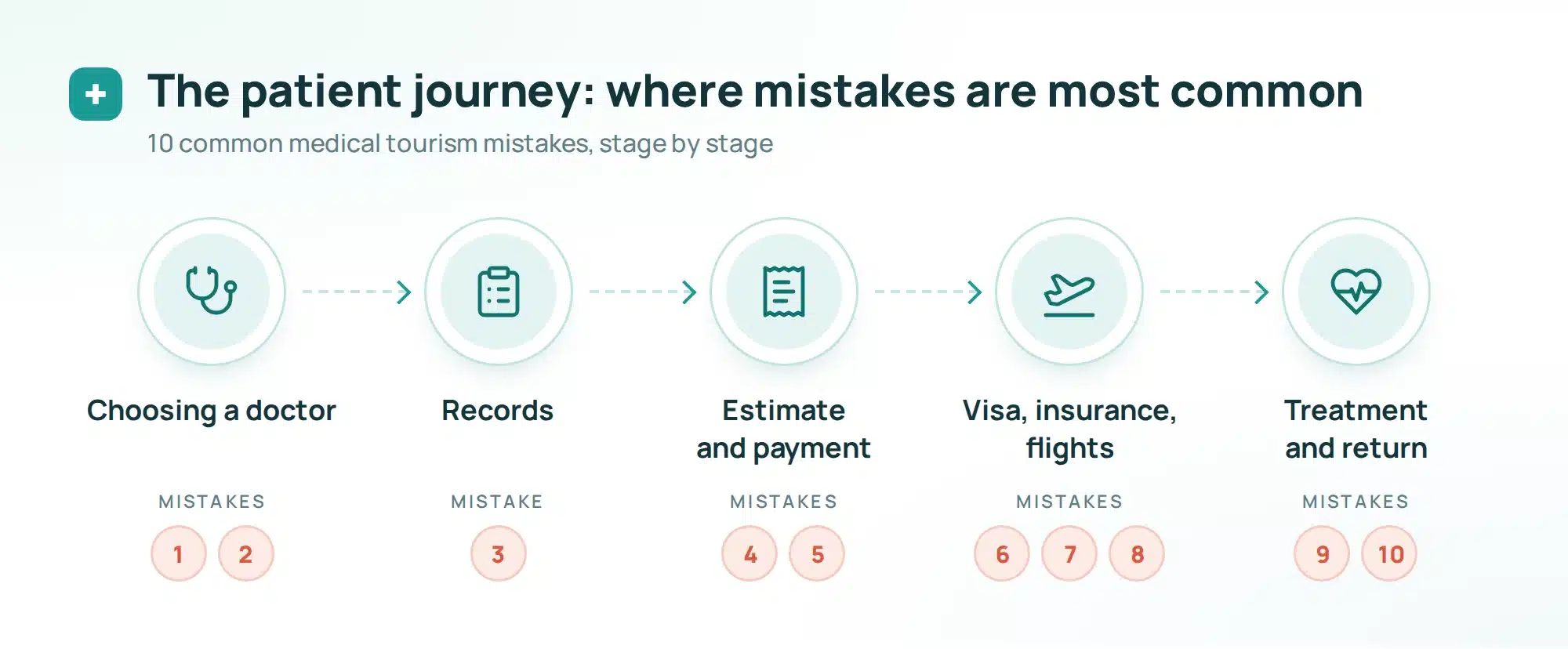
In brief: 10 rules of medical tourism
- The right doctor for your diagnosis matters more than a clinic’s advertising.
- A written opinion on your records comes before the trip, not after it.
- Records need to be complete: scans as image files, reports with a medical translation.
- Full cost estimates, not operation prices, are what deserve comparing.
- The amount, deadline and method of the advance payment are best clarified at the very start.
- The visa application goes in as soon as the clinic’s invitation arrives.
- Visa insurance does not cover planned treatment.
- Return flights need a few days in reserve and the option to change them.
- A medical interpreter and a single coordinator are not the place to economise.
- The trip home starts with a discharge report, a follow-up plan and the doctor’s contact details.
Mistake 1. Choosing a clinic by its advertising rather than a doctor for your diagnosis
A famous name, a high ranking or the lowest price does not answer the key question: how often the clinic treats your particular condition. A strong cardiology department may share a building with an ordinary urology department, and an all-inclusive package may put you in front of the wrong specialist.
The cost. When a doctor rarely sees cases like yours, the risk of extra consultations, a different clinic or repeat treatment goes up. Experience matters most in complex surgery. A US study covering 2.5 million operations found that for all 14 types of procedure studied, mortality fell as the number of such operations a hospital performed rose. The size of the gap depended on the procedure. For pancreatic resection, mortality was 16.3% in the hospitals that performed it least often and 3.8% in those that performed it most often; for carotid endarterectomy, 1.7% against 1.5% (Birkmeyer J. D. et al., 2002).
The rule. The right starting point is a doctor who regularly treats your diagnosis, and only then the clinic where they work. It is worth asking how many such operations or courses of treatment they carry out. In Switzerland, a doctor’s qualifications can be checked in MedReg, the public federal register of medical professions, which lists their diploma, specialist qualifications and cantonal licence to practise.
Mistake 2. Travelling without an opinion on your records
Sometimes flights are booked as soon as a clinic agrees to see the patient, and the doctor sees the records for the first time at the appointment.
The cost. On arrival, it may turn out that different diagnostics or a different specialist is needed, or that the treatment proposed at home deserves a rethink. The trip then stretches by days or weeks, and sometimes proves unnecessary: the same conclusion could have been reached without leaving home.
The rule. First a specialist’s opinion on the records and scans, then the decision to travel. In effect, this is a second opinion, and it usually requires no travel at all. We arrange a remote review of your records and a second opinion from a professor in the relevant field before any travel is planned. More in “A Second Opinion from a Swiss Doctor“.
Mistake 3. Sending incomplete records and scans without the image files
The clinic receives whatever is to hand: a two-year-old discharge summary, test results without dates, an MRI report instead of the scan itself. A friend or an online tool does the translation.

The cost. An estimate based on incomplete information is inaccurate. On arrival, the doctor orders repeat tests and scans, at your expense and at the cost of several days. A scan report is another doctor’s conclusion, not the scan itself, and it cannot be reviewed. Previous examinations, by contrast, help the radiologist see how things have changed.
The rule. A complete set means discharge summaries, dated test results, operation notes, histology reports and a list of medicines with doses. MRI, CT and PET scans are needed as files in DICOM format, the international standard for medical images, which lets the doctor examine the study first-hand. Reports are translated into the language the doctor works in, ideally by a translator with medical experience. We translate and organise medical records, before your trip and after your return.
Mistake 4. Comparing only the price of the operation
When comparing countries and clinics, it is tempting to compare a single figure: the price of the operation. Yet the final bill includes consultations, tests, anaesthesia, days in hospital, medicines, consumables and sometimes rehabilitation.
The cost. Whatever is missing from the estimate is added during treatment, and the option that looks cheapest on paper can end up costing more. Unforeseen events change the budget too: University Hospital Basel warns that if complications arise, the final invoice may require an additional payment. Its final invoice is drawn up 4–6 weeks after treatment, based on the services actually provided, and if it is lower than the advance payment, the difference is refunded.
The rule. Full estimates, not operation prices, are what deserve comparing. It pays to clarify what the estimate includes and what is charged separately (additional tests, implants, medicines, extra days in hospital, rehabilitation, an interpreter) and to ask in advance what happens if more is needed, for example in the event of complications. We agree the full cost estimate with the clinic and fix it before you travel, fully transparent from the outset. What the costs consist of is explained in “The Real Cost of Treatment at Swiss Clinics“.
Mistake 5. Not finding out in advance how and when to pay
Payment terms often come up only once the treatment date is set and the flights are booked.
The cost. Swiss clinics usually ask for an advance payment against the estimate before treatment. University Hospital Basel confirms the treatment date only once it has received payment. The Schulthess Klinik requires the advance payment no later than five days before treatment. University Hospital Zurich asks for the amount due to be transferred before admission. For those who need a visa, there is one more link in the chain: the Swiss Embassy in Russia, for example, requires a letter of invitation from the clinic, signed by the doctor, confirming the down payment or deposit. Until the money reaches the clinic, neither the treatment date nor the visa can move forward. Exchange rates and bank charges add to the bill.
The rule. The amount, the deadline and the payment method are best clarified at the very start, with time built in for the transfer. If a transfer from your country proves difficult, we will help you complete the payment; the options are listed in the questions at the end of the article.
Mistake 6. Leaving the visa until last
For those who need a Schengen visa, the application is often left until everything else is settled.
The cost. According to the Swiss Embassy in Russia, a decision is generally taken within 15 days, and in individual cases this period may be extended. On top of that comes the time needed to book an appointment at the visa centre. A medical visa requires the clinic’s letter of invitation confirming the advance payment, insurance and a return ticket reservation. A companion needs a complete file of their own, including the clinic’s letter of invitation and a hotel booking. If the visa is not ready by the treatment date, the treatment is postponed, and the flights and hotel with it.
The rule. The application is best submitted as soon as the clinic’s invitation arrives: the embassy recommends applying early, at the earliest six months before the journey. The companion’s documents are best prepared at the same time. We arrange the visa and the clinic’s letter of invitation, with support at every stage of the application.
Mistake 7. Relying on ordinary travel insurance
Medical insurance is required for the visa anyway, and it seems natural to assume it will also cover the treatment.
The cost. Travel insurance is designed for sudden emergencies. The NHS states plainly that most travel insurance policies will not cover planned treatment abroad, so specialist cover may be needed. For visa applicants, the Swiss Embassy requires a policy of at least EUR 30,000 covering urgent medical attention, emergency hospital treatment, repatriation for medical reasons and transport of the body; planned treatment is not on the list. If a complication arises after a planned operation, the cost is likely to fall on the patient: University Hospital Basel warns of additional payments in the event of complications.
The rule. The exclusions section of the policy deserves a careful read, and it is worth discussing with the clinic in advance what happens if additional treatment is needed and who pays for it. A reserve for unforeseen costs is best built into the budget from the start.
Mistake 8. Booking return flights too tightly
The return flight is booked for the day after discharge, to avoid paying for extra hotel nights.
The cost. The doctor may order an extra examination, recovery may take longer, and the follow-up appointment may fall on the day of departure. Flights then have to be changed and the stay extended. Flying straight after an operation is also risky. NHS Lothian’s advice for patients after abdominal surgery quotes the British Airways recommendation not to fly for 10–14 days. The NHS lists recent surgery and journeys of more than four hours, including flights, among the situations that raise the risk of deep vein thrombosis.
The rule. The departure date is best agreed with the surgeon, with a few days in reserve. A reservation of the return ticket is enough for the visa; the ticket itself is best bought with the option to change it.
Mistake 9. Economising on interpreting and coordination
It seems that the doctor speaks English, and a relative or an online translator can manage the rest.
The cost. A medical conversation covers the diagnosis, surgical risks, consent to treatment, doses and instructions after discharge. An inaccurate translation leads to repeat consultations and sometimes to mistakes with medicines. And when the patient deals with the clinic, laboratory, hotel and transfers alone, every hitch costs days.
The rule. A medical interpreter belongs at every appointment, and the arrangements are best handled by a single coordinator. We provide a medical interpreter at appointments and in everyday matters, and behind every guest stands a team of medical coordinators.
Mistake 10. Leaving without a follow-up plan
After discharge, the urge to get home is strong, and documents go into a folder unread.
The cost. Invoices and medical documents from a Swiss clinic may be in German or French: University Hospital Basel, for instance, issues its invoice exclusively in German. If the doctor at home cannot read the discharge report and there is no line to the treating doctor in Switzerland, every question about a dose, stitches or a follow-up test result turns into a new consultation, sometimes with repeat examinations. The NHS, too, reminds patients going abroad for treatment that they need to know how their aftercare will be provided when they return home.
The rule. Before departure, it pays to obtain a discharge report with recommendations and order its translation straight away, to clarify the follow-up and recovery plan, the schedule of check-ups and how to reach the treating doctor, and to show the documents to your own doctor at home. After your return, we remain at your side: records, recommendations and a direct line to your doctor.
How we help you avoid these mistakes
CorSwiss is a Swiss medical concierge: we arrange examinations and treatment at leading Swiss clinics, end to end. This is what we take on:
- a confidential, no-obligation conversation about your situation, in your language;
- a specific specialist and programme chosen for your needs;
- the cost estimate and timeline agreed in advance: the full estimate is fixed before you travel, fully transparent from the outset;
- a remote review of your records and a second opinion from a professor in the relevant field before any travel is planned;
- translation and organisation of your medical records, before your trip and after your return;
- your visa and the clinic’s letter of invitation;
- a medical interpreter at appointments and in everyday matters;
- accommodation, transfers and a personal assistant 24/7;
- after your return: records, recommendations and a direct line to your doctor.
More on the Support page. The whole journey is described step by step in “How Treatment in Switzerland Is Organised: Step by Step“.
Frequently asked questions
How long does it take to prepare for treatment abroad?
It depends on the case. Most of the time usually goes on gathering and translating records, the doctor’s opinion, the advance payment and, for those who need one, the visa: a Swiss consulate’s decision alone generally takes up to 15 days, sometimes longer. That is why it makes sense to start with the records and the first conversation and to book flights last.
Does visa insurance cover treatment?
No. A Schengen visa policy is designed for urgent medical attention, emergency hospital treatment and repatriation. Standard policies generally exclude planned treatment: as the NHS puts it, most travel insurance policies will not cover planned treatment abroad. The exclusions section of your policy is worth checking.
How is payment made?
There are several options: directly to the clinic, by bank transfer in advance or by card on site, or through CorSwiss. If a transfer from your country proves difficult, we will help you complete the payment.
Can I bring my own medicines?
Yes. For personal use, up to one month’s supply of medicines may be brought into Switzerland, based on the dosage in the prescription or package leaflet. For medicines containing narcotics, the limit corresponds to 30 days of treatment, with a certificate issued where the medicine was obtained; Swissmedic, the Swiss agency for therapeutic products, recommends carrying them in hand luggage in their original packaging.
When can I fly home after surgery?
The surgeon sets the date: it depends on the type of operation and how recovery is going. As a guide for abdominal surgery, NHS Lothian quotes the British Airways recommendation not to fly for 10–14 days. It is wise to tell the surgeon about travel plans in advance.
Do I need an interpreter if the doctor speaks English?
If you are comfortable discussing medical matters in English, perhaps not. Otherwise, yes: in a conversation about a diagnosis, surgical risks and medicines, every detail matters.
What if the estimate goes up during treatment?
It is worth asking which services have been added and why and, if the situation is not urgent, agreeing the changes before they are carried out. Swiss clinics issue the final invoice for the services actually provided a few weeks after treatment. If it is lower than the advance payment, the difference is refunded, as at University Hospital Basel and University Hospital Zurich, for example.
Sources
- Birkmeyer J. D., Siewers A. E., Finlayson E. V. et al. Hospital volume and surgical mortality in the United States. The New England Journal of Medicine, 2002 — PubMed
- Federal Office of Public Health (FOPH): MedReg register of medical professions — bag.admin.ch, register search
- DICOM Standard: About DICOM — dicomstandard.org
- RadiologyInfo.org (RSNA, ACR): Your Radiology Report — radiologyinfo.org
- University Hospital Zurich (USZ): Billing for International Patients — usz.ch
- University Hospital Basel: International Service, Your stay — unispital-basel.ch
- Schulthess Klinik: Information for international patients — schulthess-klinik.ch
- Embassy of Switzerland in Russia: Application for Schengen visa and procedure — eda.admin.ch; checklist for a medical treatment visa — PDF
- NHS: Going abroad for medical treatment — nhs.uk
- Swissmedic: Entering Switzerland with medicinal products — swissmedic.ch
- NHS Lothian: General discharge advice following abdominal surgery — PDF
- NHS: Deep vein thrombosis — nhs.uk