Switzerland has long been a byword for medical precision, innovation and an exceptional standard of service. Yet for the international patient a paradox arises: the higher the quality of medicine in a country, the harder it becomes to choose a clinic. University hospitals, private medical networks, specialised rehabilitation centres and VIP mental-health clinics — each organisation has its own area of specialisation and its own strengths.
According to international medical platforms, Switzerland is home to dozens of world-class clinics, many of which regularly feature in international rankings of the finest medical institutions in Europe and beyond. A high position in a ranking, however, does not in itself mean that a particular clinic will be the right fit for a particular patient.
‘There is no single best clinic in the abstract — there is a best clinic for your particular medical need.’ This is precisely the principle that professional medical coordinators apply when arranging treatment in Switzerland.
This article looks at six of the country’s leading clinics and examines how the right medical centre can be chosen for a specific diagnosis.
Why the choice of clinic matters so much
Modern Swiss medicine is built on narrow specialisation. One centre is regarded as a leader in oncology, another in orthopaedics, and a third in rehabilitation after stroke or in the treatment of burnout.
Several factors need to be taken into account when making a choice:
- the clinic’s specialisation;
- the experience of its doctors;
- the availability of up-to-date technology;
- the standard of service;
- the cost of treatment;
- logistics and location;
- the scope for rehabilitation after the main course of treatment.
This matters especially with complex diagnoses, where the outcome depends not only on the individual doctor but also on the work of a multidisciplinary team.
A practical guide to choosing a clinic
Before making contact, it is worth assessing a medical centre against several criteria.
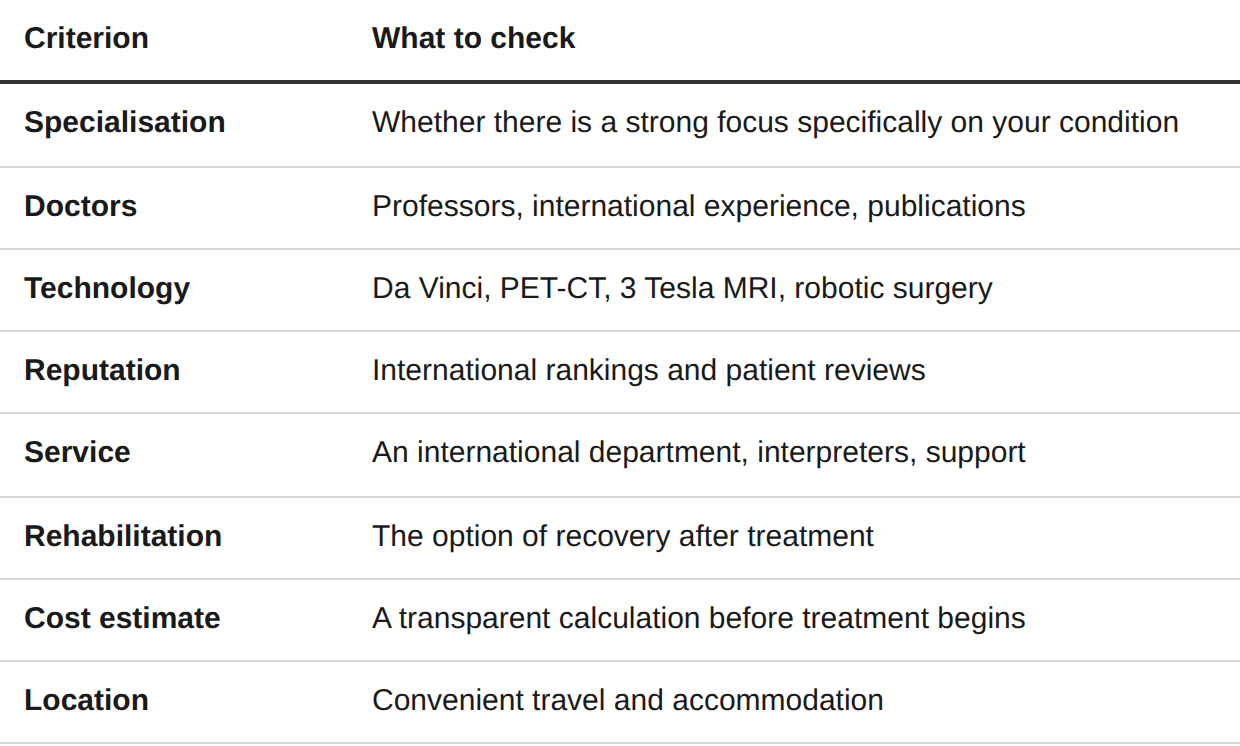
Many patients make the mistake of being guided solely by a prestigious name or by price. In reality, what matters more is the combination of specialisation and the experience of a particular team of doctors.
No. 1. University Hospital Zurich — Switzerland’s leader
University Hospital Zurich is considered one of the flagships of Swiss medicine and regularly features in international rankings of the world’s best hospitals. It is one of the largest medical institutions in the country, with around 900 beds and almost 300,000 days of care a year.
The hospital employs around 2,500 researchers across a range of medical disciplines. It works closely with the University of Zurich and ETH to develop new treatments and medicines.
Its principal strengths:
- oncology;
- cardiac and cardiovascular surgery;
- neurosurgery;
- neurology;
- transplantation medicine;
- rare diseases;
- microsurgery of the lymphatic system;
- obstetrics and gynaecology;
- urology with genetic diagnosis of prostate cancer.
USZ operates around the clock and is the only Swiss hospital to offer certain forms of therapy. A hallmark of the institution is the close collaboration between its doctors, researchers and the teaching staff of the medical university.
Who it suits
Patients with complex diagnoses or rare diseases, and those who need a second opinion or a multidisciplinary consultation.
No. 2. Privatklinik Bethanien — elite private medicine in Zurich
Bethanien is one of the most prestigious private clinics in Zurich. The institution has been operating for more than 110 years and sits on the Zürichberg hillside, overlooking Lake Zurich and the city. Since 2010 it has been part of Swiss Medical Network and a member of the Mayo Clinic Care Network. In October 2024 Bethanien merged with Klinik Pyramide am See, strengthening its surgical and aesthetic profile.
The clinic draws on around 390 accredited doctors. Its main areas of specialisation:
- orthopaedic surgery;
- gynaecology and obstetrics;
- visceral surgery;
- cardiology;
- urology;
- neurosurgery and spinal surgery;
- thoracic surgery;
- oncology;
- gastroenterology;
- and more than 13 further specialist centres.
What sets Bethanien apart is its personalised approach and access to a network of specialist consultants within a single institution. The clinic works extensively with international patients and offers a high standard of care coordination.
Who it suits
Those who prefer private clinics, an individual approach and comfort on a par with a five-star hotel.
No. 3. Clinique de Genolier — a flagship of premium medicine
Clinique de Genolier was founded in 1972 and is considered one of the largest private clinics in Switzerland. It stands on high ground overlooking Lake Geneva and the Alps. The clinic belongs to Swiss Medical Network — the country’s largest private medical network (21 clinics and more than 80 centres across all of its language regions) — and is a member of the Mayo Clinic Care Network.
The clinic has around 100 beds and works with 230 doctors and 340 staff. Its key areas:
- oncology (with its own cancer centre);
- cardiology;
- orthopaedic and vascular surgery;
- neurosurgery;
- gastroenterology;
- physiotherapy and rehabilitation;
- specialist centres for diabetes, pain management and radiology.
Its chief advantage is the combination of high medical standards, advanced diagnostics and service on a par with a premium hotel.
Who it suits
Patients for whom comfort, privacy and comprehensive treatment in a single centre matter — particularly in oncological, cardiological and complex surgical cases.
No. 4. Ars Medica Clinic — the orthopaedic leader in Ticino
Ars Medica Clinic is located in Gravesano, 7 km north of Lugano, in the canton of Ticino. It is the official Reference Center in Ticino for orthopaedic surgery and musculoskeletal traumatology.
Its main areas:
- spinal surgery (Centro Colonna Vertebrale);
- sports medicine (Centro dello Sport);
- orthopaedic surgery and joint replacement;
- traumatology;
- emergency orthopaedic care;
- radiology;
- physiotherapy and rehabilitation medicine;
- pain management.
Professional athletes come here, as do patients who need a swift return to an active life. Particular attention is paid to post-operative rehabilitation.
Who it suits
Patients with joint and spinal conditions or sports injuries, as well as athletes recovering from injury.
No. 5. CALDA Clinic — a world centre for treating burnout and addiction
While most Swiss clinics are associated with surgery or diagnostics, CALDA occupies a unique niche — it is one of Europe’s best-known centres for the treatment of mental-health disorders and addiction.
What is treated here:
- burnout and stress;
- depression (including post-natal depression);
- anxiety disorders and phobias;
- eating disorders;
- ADHD and obsessive-compulsive disorder;
- post-traumatic conditions;
- alcohol and drug dependence;
- behavioural addictions.
Distinctive features of the model:
- in-depth diagnostics at both the psychological and physical level, including genetic and orthomolecular analysis;
- integrative treatment: modern psychiatry combined with acupuncture, art therapy, meditation and equine therapy;
- a personal psychiatrist available around the clock (Russian-speaking specialists are available);
- complete confidentiality — VIP transfer, direct access to the apartment from the garage, and minimal involvement of third parties;
- a limited number of patients treated at any one time.
Who it suits
Business people, executives, public figures and patients who require absolute privacy and individual support.
No. 6. The Bad Ragaz wellness centre
Grand Resort Bad Ragaz is a luxury resort with an integrated Tamina Health Center that has been a place of healing since 1242. Today it is regarded as one of the leaders in:
- preventive medicine and longevity programmes;
- detox and weight-loss programmes;
- check-up programmes (Health Check-up);
- sports medicine (Swiss Olympic Medical Center);
- recovery and wellness programmes.
What distinguishes the complex is the integration of medical procedures and recovery programmes with world-class resort facilities and thermal springs. Its dining has been awarded 6 Michelin stars.
Who it suits
Patients who are looking for preventive diagnostics, recovery programmes after physical strain, sports medicine and all-round wellness in a resort setting.
How to choose a clinic for a specific need

Oncology
- What matters: molecular tumour profiling, access to targeted therapy and immunotherapy, and a multidisciplinary tumour board for your type of cancer.
- Technology to look for: PET-CT, the latest generation of linear accelerators, proton therapy (where relevant to the diagnosis) and full genetic profiling of the tumour.
- Questions for the clinic: how many cases of your specific diagnosis are treated each year, how often the tumour board meets, and whether there is access to clinical trials.
- Suitable clinics: University Hospital Zurich, Genolier, Bethanien.
Cardiology and cardiac surgery
- What matters: the operator’s personal experience (the number of procedures performed has a direct bearing on risk), access to minimally invasive techniques, and hybrid operating theatres.
- Technology to look for: transcatheter techniques (TAVI, MitraClip), Da Vinci robotic surgery and a hybrid operating theatre.
- Questions for the clinic: how many such operations the surgeon has personally performed, what the mortality rate is for this type of procedure, and whether cardiac rehabilitation is provided on site.
- Suitable clinics: University Hospital Zurich, Genolier, Bethanien.
Orthopaedics and sports medicine
- What matters: the surgeon’s experience with the specific implant, the presence of a spine and sports-medicine centre, and a rehabilitation programme within the clinic or a partner centre.
- Technology to look for: robotic joint replacement, navigation in spinal surgery, shockwave therapy and joint arthroscopy.
- Questions for the clinic: which implants are used, whether they are included in the quotation, how many days of rehabilitation are involved, and whether the same team oversees it.
- Suitable clinics: Ars Medica Clinic (Ticino), Bethanien (Zurich); for sports medicine, the Bad Ragaz wellness centre.
Rehabilitation
- What matters: the focus of the rehabilitation (orthopaedic, neurological, cardiological or sports), the length of the programme, and the tools used to measure progress.
- Technology to look for: hydrokinesitherapy, robotic rehabilitation for walking and for the arms, and aquatic training.
- Questions for the clinic: how many sessions are planned each day, who looks after the patient (a single team or a rotating one), how progress is assessed, and whether the programme can be extended.
- Suitable centres: Bad Ragaz (preventive and sports rehabilitation), Genolier (post-operative), and specialist rehabilitation clinics within partner networks.
Mental health, addiction and burnout
- What matters: an individual approach (a limited number of patients treated at any one time), complete confidentiality, and the length of the programme and intensity of support.
- Approaches to look for: integrative psychiatry (psychotherapy + biochemistry + complementary methods), a personal psychiatrist available around the clock, and orthomolecular diagnostics.
- Questions for the clinic: how many patients are in the clinic at the same time, how privacy is ensured (a separate entrance, apartments), and whether Russian-speaking specialists are available.
- Suitable clinic: CALDA Clinic.
Preventive medicine and check-ups
- What matters: the format and scope of the programme (one to three days, and what is included) and the availability of specialist streams (longevity, detox, weight loss, sports medicine).
- Technology to look for: 3 Tesla MRI, low-dose CT, an extended laboratory panel, microbiome tests, genetics and a cardiac stress test.
- Questions for the clinic: what the basic package includes, how an individual programme is put together, and what form the final report and post-check-up support take.
- Suitable clinics: Bad Ragaz, Genolier, University Hospital Zurich.
Gynaecology, fertility and childbirth
- What matters: the presence of a neonatal intensive care unit, experience with IVF, and programmes for older expectant mothers.
- Technology to look for: 4D ultrasound, pre-implantation genetic diagnosis, epidural anaesthesia on request, and operating theatres equipped for minimally invasive surgery.
- Questions for the clinic: how many births and IVF cycles take place each year, what the complication statistics are, and whether psychological support is available.
- Suitable clinics: University Hospital Zurich, Bethanien, Genolier.
Checklist: 10 questions to ask before choosing a clinic
Before a final decision is made, the following questions are well worth asking:
- How many similar cases are treated each year?
- Who will my treating doctor be?
- Will the professor be personally involved in the treatment?
- Is there an international department?
- What technology is used?
- What is included in the cost of treatment?
- Is there a rehabilitation programme?
- What outcomes are achieved for my condition?
- Is it possible to obtain a second opinion?
- Is Russian-speaking support available?
Common mistakes patients make
The main mistakes made when choosing a clinic in Switzerland:
- Choosing on price alone. A low price almost always means a pared-down package: no private room, no interpreter, no rehabilitation. Sometimes it also means a less experienced surgeon, or a clinic with no dedicated track record in your condition.
- Choosing on ranking alone. An institution in the world’s top 100 is not necessarily strong in the area you need: general rankings average performance across more than 30 specialities. What matters is the ranking within the specific field, not the overall one.
- Overlooking the individual doctor. Sometimes it is not the clinic but the professor or surgeon who proves decisive. It is worth finding out who is personally handling the case, how many similar operations they have performed, and what they have published on your condition.
- Declining a second opinion. In oncology, neurosurgery and cardiac surgery a second assessment often changes the plan: different priorities, a different approach, a different extent of surgery.
- Underestimating rehabilitation. After orthopaedic, neurosurgical and cardiac procedures the outcome depends heavily on recovery. Rehabilitation is often charged separately, so it is best budgeted for in advance.
- Sending medical records too late. Without discharge summaries, test results and scans, a clinic cannot provide a realistic quotation. The later the information is sent, the more surprises there tend to be after arrival.
- Travel insurance that does not cover planned procedures. A standard Schengen policy does not cover planned surgery, complications or an extended hospital stay. A separate medical policy is needed, with cover of at least €30,000 for emergency care and repatriation.
- Buying tickets before the appointment date is confirmed. Doctors’ schedules in Switzerland are booked well in advance, and fixed tickets often have to be changed at a loss.
- Having no follow-up plan for after the return home. Who will issue prescriptions at home, who will monitor test results and scans, and who will adjust the therapy — these are best agreed before arrival.
- Unclear terms for the return of the deposit. Swiss clinics usually require payment in advance. It is best clarified at the outset whether the difference is refunded if the final sum turns out to be lower than the quotation.
- Overlooking the accompanying person. The visa, insurance and accommodation for a companion are a separate cost. If a relative is travelling too, their documents and budget also need to be planned in advance.
- Hidden costs for implants and consumables. Depending on the clinic, these are either included in the package or listed as a separate line. An itemised quotation, broken down by item rather than a single overall figure, is well worth requesting.
How the exact cost of treatment is determined
Almost all the leading Swiss clinics work to a similar process:
- The patient sends their medical records.
- The doctors carry out a preliminary assessment of the case.
- An individual treatment plan is drawn up.
- The clinic prepares an itemised quotation.
- Once this is agreed, the arrangements for the trip begin.
It is worth bearing in mind that the final cost depends on the diagnosis, the length of the hospital stay, any additional investigations and whether rehabilitation is required.