Treatment in Switzerland is often surrounded by myths. The main one goes like this: only oligarchs, celebrities and patients with large budgets go there, and prices are supposedly higher than in the USA. In practice, the picture is more nuanced. Switzerland does belong to the premium medical segment, but that does not always mean “out of reach”. According to medical coordinators, prices at Swiss clinics are often comparable to those in Germany and France, and some diagnostic programmes cost less than patients expect, given the country’s reputation as the most expensive in Europe.
Switzerland is predictable premium medicine rather than a budget destination. The patient pays for a whole system rather than a single operation or consultation: precise diagnostics, a high level of physician accountability, well-organised processes, short waiting times, privacy, service and access to practising professors. As sources online put it, the advantages of preventive check-ups include “fast appointments and short waiting times”, individual programmes, transfers, an interpreter and accommodation arranged through a personal case manager.
What determines the cost of treatment
The cost of treatment in Switzerland cannot be fairly assessed with a single average figure. Several factors influence the price.
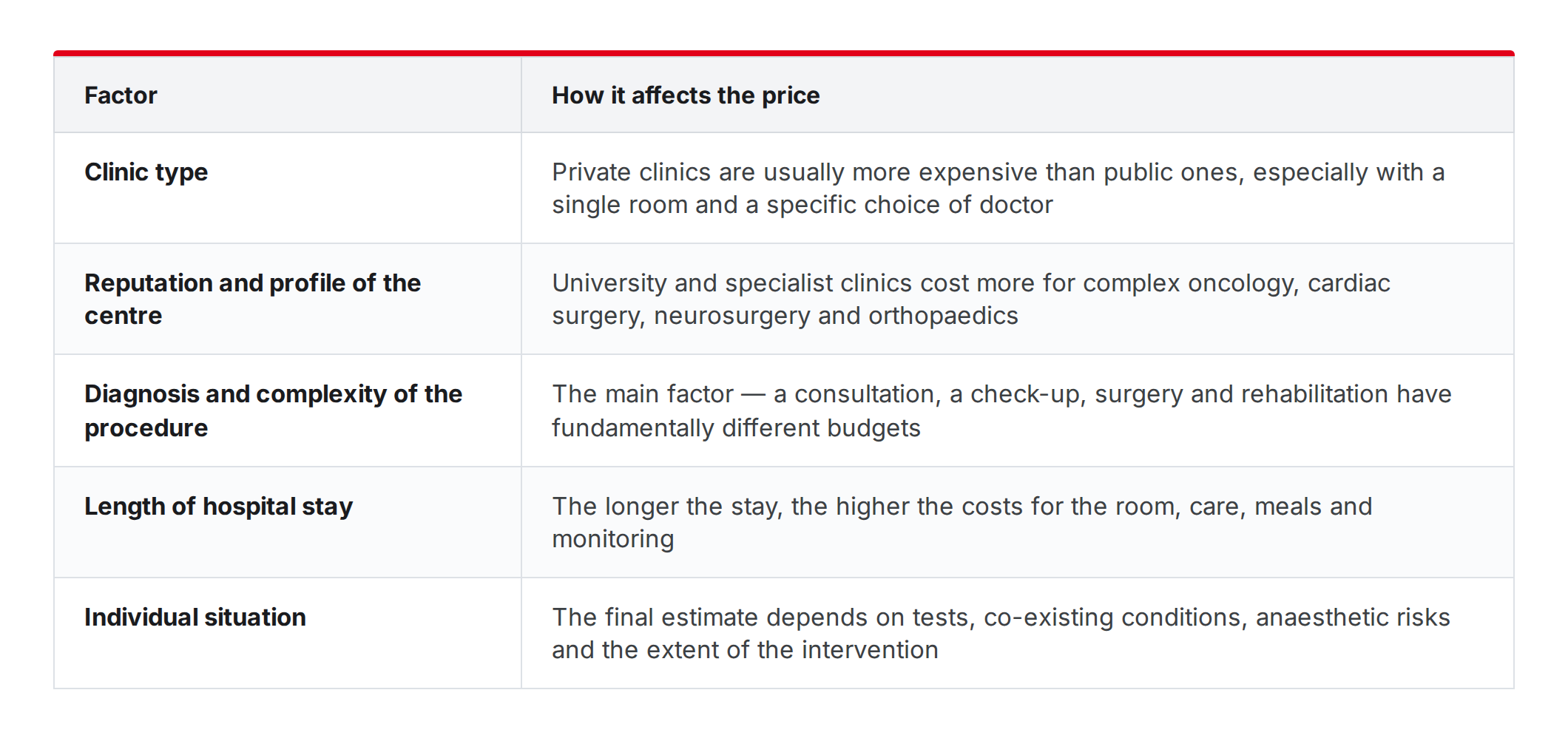
A preliminary price is almost always an estimate. Swiss Medical Network states clearly that the initial cost estimate is calculated on the basis of the patient’s medical records, and that additional tests or an extended stay may change the final cost.
Diagnostics and consultations: real price ranges
For a patient who is still choosing a country for treatment, diagnostics are the clearest entry point into Swiss medicine. An individual medical examination with a consultation with an internist, abdominal ultrasound, blood and urine tests, an ECG and a written report starts at around CHF 3,400.
Organ-specific programmes vary in price:
- dermatology — from CHF 300
- urology — from CHF 800
- ophthalmology — from CHF 800
- gynaecology — from CHF 1,200
- cardiology — from CHF 2,900
- gastroenterology — from CHF 2,500 for a colonoscopy and consultation, or around CHF 4,800 for an extended examination
The medical tourism market also offers other reference points for comprehensive programmes:
- standard check-up — around CHF 2,800
- men’s diagnostics — around CHF 2,000
- women’s diagnostics — around CHF 3,000
- examination for cardiovascular disease — around CHF 5,000
- full gastrointestinal (GI) diagnostics — around CHF 3,000
- extended cardiac examination with consultation and therapy — around CHF 7,000
- CT with report — around CHF 7,000
- urological or gynaecological examination — CHF 1,500–2,000
- mammography — CHF 1,500–2,000
- whole-body ultrasound of veins and arteries — around CHF 2,900
- gastroscopy with biopsy, colonoscopy with biopsy, ultrasound of the organs — around CHF 3,900
The spread is easy to explain: a check-up can mean anything from a basic set of tests to an intensive programme with MRI, CT, genetics, endoscopy and consultations with several specialists. Prices are given in Swiss francs.
Treatment prices by specialty
Gastroenterology
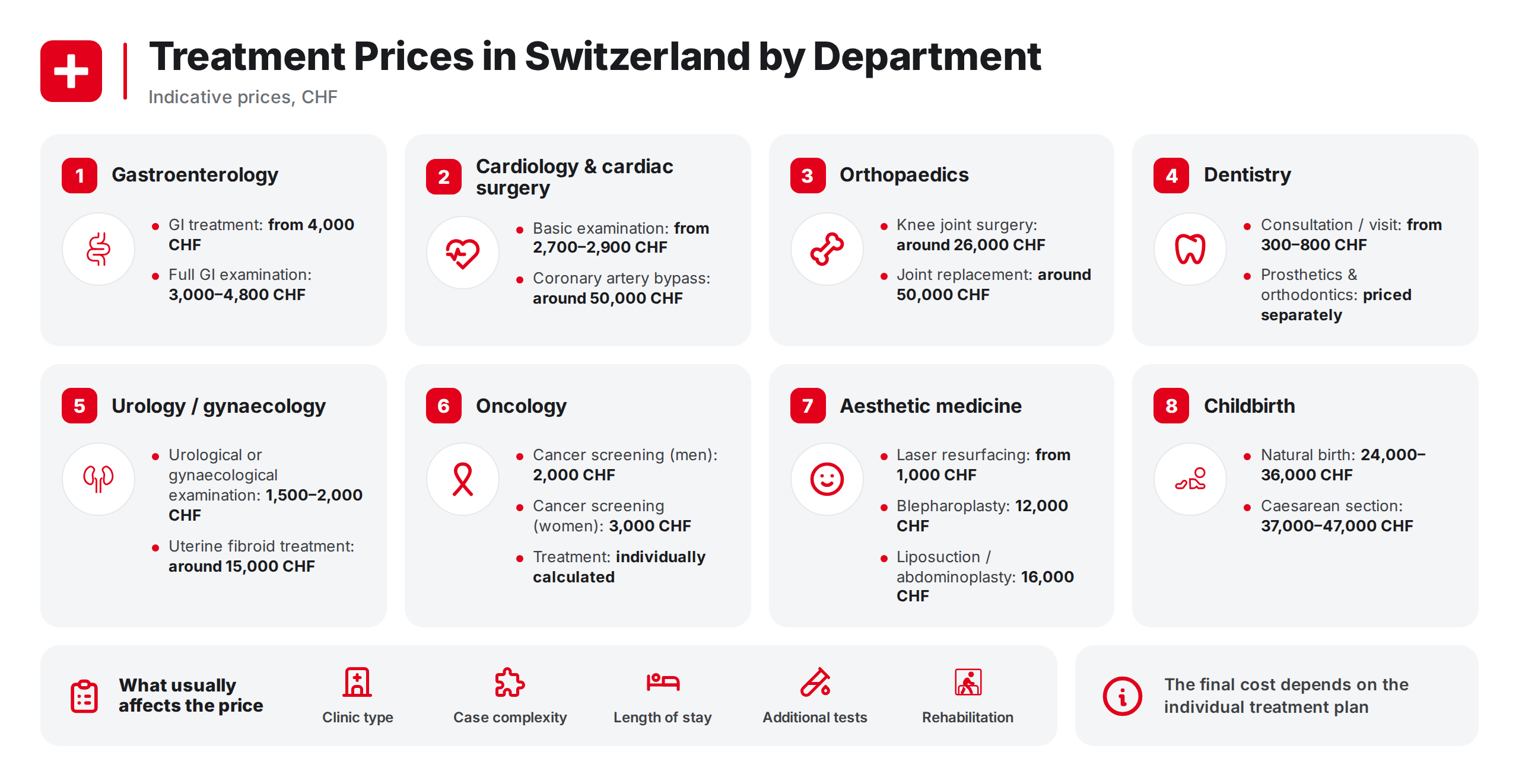
Basic treatment of digestive disorders is estimated at around CHF 4,000. Extended GI diagnostics at Swiss clinics can cost around CHF 4,800 if they include gastroscopy, colonoscopy, ultrasound and laboratory tests.
Cardiology and cardiac surgery
Indicative prices in this specialty:
- cardiology check-up — from CHF 2,900
- comprehensive cardiac diagnostics — from CHF 3,500
- stenting — from CHF 15,000
- coronary artery bypass grafting — from CHF 45,000–50,000
This is already the realm of complex medicine, where the price depends on the surgical approach, implants, the length of intensive-care monitoring and rehabilitation.
Orthopaedics
Orthopaedics is one of the most sought-after specialties. Indicative prices for operations:
- knee surgery — around CHF 26,000
- knee or hip joint replacement — around CHF 50,000
Such packages often include hospitalisation, the room, meals, the operating theatre, anaesthesia, the surgeon’s and assistant’s fees, and physiotherapy. This is worth clarifying: one clinic includes the implant in the package, while another lists it as a separate item.
Dentistry
Dentistry in Switzerland is expensive even by European standards. A visit to a general dentist costs from CHF 800, excluding prosthetics and orthodontics. Many clinics give a gentler reference point for a preventive dental examination — from CHF 300. The difference comes down to scope: an examination, X-rays, restorative treatment, implantology and aesthetic dentistry are all different budgets.
Urology, gynaecology, oncology
Reference prices for urology and gynaecology:
- urological examination — from CHF 800
- gynaecological examination — from CHF 1,200
- ultrasound treatment of uterine fibroids — around CHF 15,000
- robotic prostatectomy — CHF 40,000–50,000
Oncology almost never has an honest “average price”: the cost depends on the type of tumour, its stage, molecular diagnostics, surgery, radiotherapy, targeted drugs, immunotherapy and the length of follow-up. In practice, a cost estimate may start in the tens of thousands of francs and rise considerably with complex protocols.
Aesthetic medicine
Aesthetic operations are paid for separately and are usually not covered by basic insurance. Reference prices for the main procedures:
- laser resurfacing — from CHF 1,000
- blepharoplasty — around CHF 12,000
- liposuction — around CHF 16,000
- abdominoplasty — around CHF 16,000
- full facelift — around CHF 25,000
Childbirth
Childbirth is one of the best-known premium packages. Reference prices at Swiss clinics:
- natural birth — from CHF 20,000 to CHF 36,000
- caesarean section — from CHF 25,000 to CHF 47,000
The package usually includes doctors’ fees, the stay at the clinic, medication, procedures and initial care of the newborn, but accommodation before the birth, the hotel, transfers and additional examinations need to be checked separately.
Hidden and additional costs
The patient’s main mistake is to compare only the price of the operation. Additional costs can change the budget noticeably:
- medication and consumables, if they are not included in the package
- additional tests, MRI, CT, biopsies, consultations with related specialists
- an extended hospital stay
- accommodation after discharge
- transfers, flights, an interpreter
- meals and accommodation for an accompanying person
- travel insurance
- rehabilitation after surgery
Swiss Medical Network states plainly that if additional tests or an extended stay are needed during treatment, the changes are agreed with the patient and charged separately. So the right question to ask a clinic is “What is included in the price, and what is charged separately?” rather than “How much does the operation cost?”
Comparison with other countries
Switzerland is more expensive than the average European destination, but not always more expensive than the USA. According to OECD data for 2024, the USA spent more than USD 14,880 PPP per person on healthcare, while Switzerland, Norway and Germany were in the range of roughly USD 9,300–10,000 PPP. This is not a direct price list for operations, but it is a good macro indicator: American medicine remains, on average, the most expensive among developed countries.
The differences with Germany are smaller. Medical coordinators state plainly that prices in Switzerland do not always differ much from those in Germany or France. Israel, Turkey, the Czech Republic and South Korea are often cheaper, but any comparison should take into account access to a specific doctor, technology, timelines, safety and post-operative support as well as price.
Health insurance for foreigners
For Swiss residents the rules are clear: everyone who settles in the country must take out basic health insurance within three months. The Swiss Federal Office of Public Health states that the standard deductible is CHF 300 per year, and the maximum annual co-payment for an adult patient after the deductible is CHF 700. The average monthly premium for compulsory insurance in 2026 is CHF 393.30.
For tourists and patients coming for planned treatment, the situation is different: ordinary travel insurance does not always cover a planned operation. You need a policy with clear terms for emergency care, complications, hospitalisation, repatriation and assistance. Basic Swiss insurance for residents covers a wide range of medical services, but it is not a universal “pays for everything” solution: cosmetic procedures and routine dentistry are, as a rule, not included.
How to get an accurate cost
The process should look like this:
- Gather your medical records: discharge summaries, imaging, test results, reports.
- Send them to the clinic’s international department or to a medical coordinator.
- Receive a preliminary treatment programme.
- Request a detailed cost estimate: doctor, room, operation, anaesthesia, implants, medication, rehabilitation, interpreter, transfers.
- Separately clarify the terms for refunding the deposit if the actual amount turns out to be lower.
- Ask what happens in the event of complications or an extended stay.
A good cost estimate should be transparent before treatment begins. If a clinic or intermediary gives only a single total figure without a breakdown, the risk of additional costs is higher.
The best clinics in Switzerland
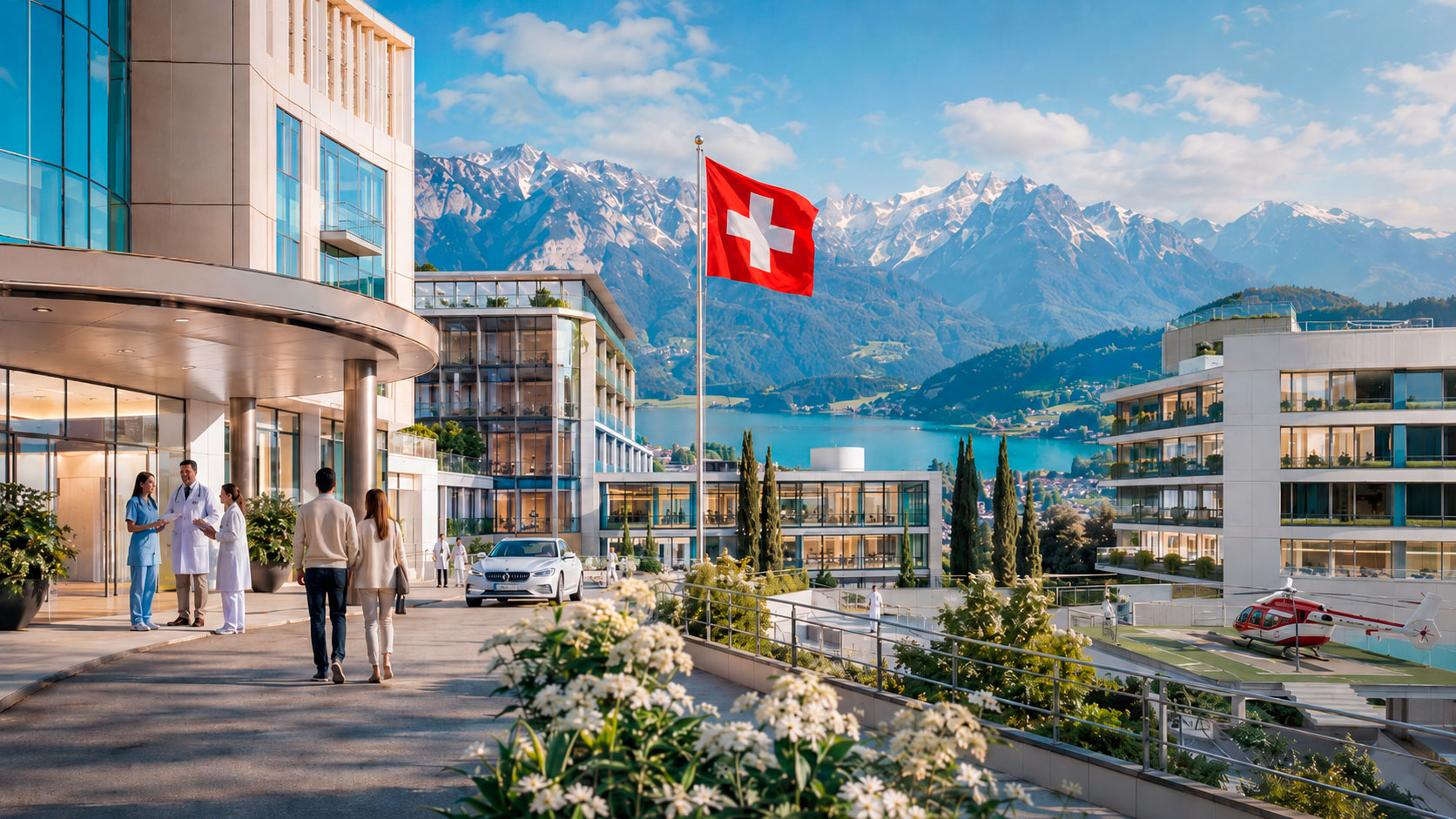
Switzerland is rightly regarded as one of the best countries in the world for medicine. Below is an indicative list of leading clinics and centres, with a brief description of each one’s profile.
- Clinique Nescens — regenerative medicine and cellular rejuvenation using the patient’s own stem cells, aesthetic medicine and longevity programmes.
- University Hospital Zurich (USZ) — a large public multidisciplinary institution that brings together 43 departments and covers practically every field of medicine (from primary care to high-tech cases), and conducts research.
- CALDA Clinic — a premium institution specialising in the treatment and in-depth diagnosis of mental health disorders: trauma, addiction, depression, personality disorders; it combines modern psychiatry with integrative methods (Ayurveda, acupuncture, art therapy and equine therapy).
- The Gentlemen’s Clinic — a men’s clinic for cosmetic and aesthetic medicine: plastic surgery, minimally invasive procedures, dermatology, trichology (hair restoration) and lifestyle coaching.
- Paracelsus Recovery — treatment of addictions (alcohol, drugs, gambling), eating disorders and behavioural disorders with an individual therapeutic programme.
- Hôpital de la Providence — orthopaedics and traumatology (the leading department in the Neuchâtel region), ophthalmology and one of the largest haemodialysis centres in Switzerland.
- Clinique des Eaux-Vives — a multidisciplinary medical, surgical and oncology centre in Geneva: orthopaedics and traumatology, paediatrics, pulmonology, angiology, radiology, haematology; radiotherapy, chemotherapy, immunotherapy and hormone therapy for cancer.
- Professor Sailer’s Clinic — a leading centre for maxillofacial and reconstructive surgery: aesthetic surgery, dentistry and implantology, facial feminisation, and treatment of snoring and sleep apnoea.
- Privatklinik Obach — a private surgical clinic founded in 1922; orthopaedics, traumatology, shoulder surgery, general and visceral (abdominal) surgery, gynaecology, urology, plastic surgery, ophthalmology; more than 4,000 operations a year.
- Klinik Lindberg — a multidisciplinary institution with 95 doctors: general, visceral and neurosurgery, cardiology, oncology and haematology, orthopaedics and physiotherapy, comprehensive obesity therapy, traditional Chinese medicine.
This is a useful guide, but it does not replace an individual choice. The best clinic is not necessarily the most expensive or the best known. In oncology, the tumour profile matters; in orthopaedics, the surgeon’s experience with a specific type of implant; in cardiology, access to the right technology; in rehabilitation, the team and the length of the programme. As a coordinator, CorSwiss helps select the most suitable medical institution for each patient’s needs and arranges support at every stage.
The real cost of treatment in Switzerland is higher than the European average, but the myth of “medicine only for billionaires” is exaggerated. Basic diagnostics can cost a few thousand francs, complex operations tens of thousands, childbirth and orthopaedics from CHF 20,000 to CHF 50,000 and more, and oncology is calculated individually.
Switzerland’s main value lies in predictability, quality, service, precise diagnostics and accountability. A patient with a budget for the best private clinics in Moscow can often genuinely consider Switzerland as a realistic option, especially if they obtain a detailed cost estimate in advance.
Our key advice: look beyond price and rankings. Compare what is included in the package, the doctor’s experience, the treatment technology, the hospitalisation conditions and the rules for paying additional costs. In Swiss medicine, what you are really paying for is the certainty that the entire patient journey has been thought through in advance, as well as the procedure itself.