Switzerland and Germany are regarded as two of the most advanced healthcare systems in Europe, and both countries welcome patients from all over the world. Germany is known for its large university hospitals, advanced diagnostics and strong rehabilitation medicine. Switzerland is often chosen by patients who value innovative treatments, an individual approach and a high standard of medical service. The final choice depends on the complexity of the condition, the treatment timeline and the patient’s preferences.
Why patients choose treatment in Europe
European medicine has long been considered a benchmark of quality thanks to strict standards and the development of scientific medicine. Patients choose European clinics for several reasons:
- evidence-based medicine
- strict quality control of treatment
- access to modern medical technology
- high standards of safety and diagnostics
- clinics’ participation in international research
Many European medical centres work closely with research institutes and pharmaceutical companies, which allows new treatments to be introduced faster than in most countries.
The World Health Organization emphasises that a high level of standardisation in medical care is one of the key factors in the successful treatment of complex diseases.
The healthcare system in Switzerland
Medical technology and innovation
Switzerland is regarded as one of the most technologically advanced healthcare systems in Europe. Private clinics are quick to adopt modern diagnostic methods, including high-precision MRI, molecular diagnostics and genetic testing.
Many medical centres work in close partnership with pharmaceutical companies and research laboratories. This makes it possible to introduce innovative therapies, including targeted treatment and personalised medicine.
A personalised approach to the patient
One of the hallmarks of Swiss medicine is its individual approach. Medical teams develop a personal treatment strategy based on:
- the patient’s medical history
- genetic factors
- the results of extended diagnostics
- international clinical guidelines
Main areas of treatment
Swiss clinics are particularly renowned in the following fields:
- oncology
- cardiology
- neurosurgery
- orthopaedics and sports medicine
- complex diagnostics
Many clinics welcome patients from different countries, and their international departments specialise in supporting patients from abroad.
Why Switzerland has long been a centre of international medicine
For many decades, Switzerland has attracted patients from all over the world. There are several reasons for this:
- a high concentration of specialised private clinics
- modern medical equipment
- close links between medicine and scientific research
- a high standard of service and patient support
- strict quality standards in medical care
As a result, the country has become one of the key centres of international medical travel.
The healthcare system in Germany
An extensive network of university hospitals
Germany is known for its large university medical centres, which combine treatment, medical training and scientific research. Such hospitals often take part in international clinical trials.
High-quality diagnostics
German clinics have a well-developed diagnostic infrastructure. Patients can undergo:
- comprehensive laboratory tests
- functional diagnostics
- high-precision imaging
- genetic tests
This enables doctors to establish an accurate diagnosis and choose the optimal treatment approach.
A strong rehabilitation system
Germany is widely known for its well-developed rehabilitation system and network of specialised centres, including neurological and orthopaedic rehabilitation. After surgery, patients can undergo recovery treatment at specialised centres.
Main areas of treatment
The strongest fields of German medicine are considered to be:
- oncology
- cardiac surgery
- orthopaedics
- transplantation
- neurology
Key differences between Swiss and German medicine
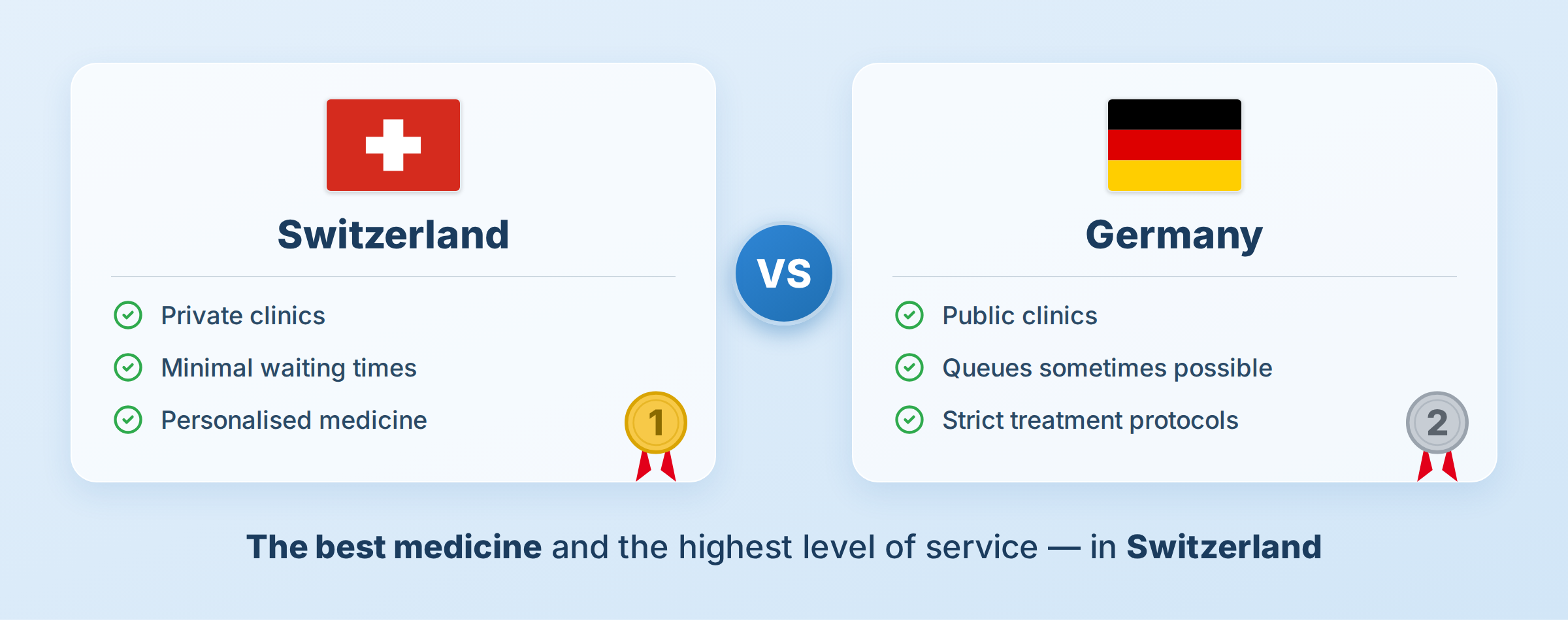
| Criterion | Switzerland | Germany |
| Standard of medicine | Very high, with a focus on innovation | Very high, especially at university hospitals |
| Type of clinic | Mainly private specialised centres | A strong network of university and public hospitals |
| Cost of treatment | Usually higher | More affordable |
| Waiting times | Generally shorter | Waiting lists are sometimes possible |
| Level of service | Very high, personalised | High, but more standardised |
Switzerland has historically attracted international patients through its combination of innovative technology, high medical standards and an individual approach to treatment.
Cost of treatment
The cost of treatment can vary considerably depending on a number of factors:
- the scope of diagnostics
- the complexity of the condition
- whether surgery is required
- the length of hospital stay
- subsequent rehabilitation
Overall, treatment in Switzerland tends to be more expensive. This reflects the use of the latest technology, the high qualifications of specialists and the standard of medical service.
Patients often regard the cost of treatment as an investment in the quality of medical care and in access to innovative therapies.
When Switzerland is the better choice
Swiss clinics may be the optimal choice in the following situations:
- complex or rare diseases
- the need for personalised treatment
- obtaining a second medical opinion
- the need for innovative therapies
- a high standard of service and personal support
- rapid access to specialists
In such cases, patients often choose specialised private clinics.
When Germany may be the more suitable option
Germany also remains a popular destination for medical travel. It may be the more suitable choice in the following cases:
- a limited budget
- standard medical procedures
- treatment at large university hospitals
- the need for long-term rehabilitation
The German healthcare system is well suited to comprehensive treatment followed by recovery.
How to arrange treatment abroad
Arranging treatment abroad usually involves several stages:
- Choosing a clinic and a doctor
- Sending medical records for preliminary review
- Receiving a medical invitation
- Obtaining a medical visa
- Planning the trip and hospital stay
Many patients turn to specialised medical coordinators. CorSwiss, for example, helps patients choose a clinic in Switzerland, arranges consultations with doctors and accompanies the patient at every stage of treatment.
Both Switzerland and Germany offer a high standard of medicine and modern treatment technology. Germany is known for its extensive network of university hospitals and strong rehabilitation system. Switzerland is often chosen by patients who value innovative treatments, a personalised approach and a high standard of medical service.
That is why, for complex conditions or where innovative or individual treatment is needed, patients often regard Swiss clinics as one of the most attractive options.
FAQ
Where is cancer best treated: in Switzerland or Germany?
Both countries have strong cancer centres. Germany is known for its university hospitals and large research programmes. Switzerland often offers a more personalised approach and access to innovative therapies.
Is there a big difference in the cost of treatment?
Yes, treatment in Switzerland is usually more expensive. This reflects the level of technology, the individual approach and the high standard of medical service.
How long does it take to arrange treatment?
Preparing the trip and agreeing the treatment usually takes anywhere from a few days to a few weeks, depending on the complexity of the case and the chosen clinic.
Do I need to speak the language to be treated?
No. Many clinics have international departments and interpreters who assist patients at every stage of treatment.
Can I obtain a second medical opinion?
Yes. Many European clinics offer a second-opinion service. Patients can send their medical records and receive a specialist consultation remotely.