
Organising treatment abroad involves far more than choosing a clinic and buying tickets. The patient faces a whole series of tasks: understanding another country’s healthcare system, finding the right specialist, translating medical records, and coordinating the timing of examinations and treatment. A mistake at any stage can lead to lost time, unnecessary costs and even less effective therapy.
Switzerland is rightly regarded as one of the leading destinations for medical travel. It is home to world-renowned clinics, advanced diagnostic and treatment methods are used, and the level of service meets the highest standards. Yet it is precisely because of the high degree of specialisation and the diversity of medical institutions that organising treatment on your own becomes particularly complex.
This is where a case manager comes in — a specialist who takes on the coordination of every process and helps the patient through their treatment as effectively and calmly as possible.
What is a case manager?
A case manager is a specialist who supports the patient at every stage of organising and undergoing treatment. Their role goes beyond logistics: they build the optimal pathway of medical care based on the patient’s specific situation.
It is important to understand that a case manager differs from a medical coordinator or an interpreter. An interpreter handles language support only, and a coordinator handles organisational matters. A case manager combines these functions and adds analytical and expert work: they assess the medical data, help choose a treatment strategy and oversee its implementation.
This role is most often filled by specialists with a medical education or experience in healthcare. This allows them to understand diagnoses, find their way around treatment methods and work with doctors on a professional level.
What does a case manager do?
- Selecting the clinic and doctor
The case manager selects the medical institution and specialist based on the diagnosis and the particular features of the case. In Switzerland this is especially important because clinics are highly specialised. - Organising diagnostics and treatment
The specialist draws up an examination plan, books appointments and coordinates the schedule. This helps to build effective treatment, especially when several doctors are involved. - Handling medical records
The case manager arranges the translation of reports, the preparation of discharge summaries and the accurate transfer of information between specialists. This reduces the risk of errors and misunderstandings. - Supporting the patient
During the stay in the country, they help resolve organisational matters and coordinate communication with the clinic. The patient receives support at every stage of treatment. - Monitoring the quality of treatment
The case manager ensures that the treatment plan is followed and that every process is transparent. They also make sure the patient receives complete and clear information.
Why a case manager is especially important in Switzerland
The high standard of medicine in Switzerland is both an advantage and a challenge. The healthcare system here is deeply specialised: each clinic, and even individual doctors, may focus on narrow fields.
This means that choosing the right specialist becomes critically important. The wrong decision can lead to lost time or the need for additional examinations.
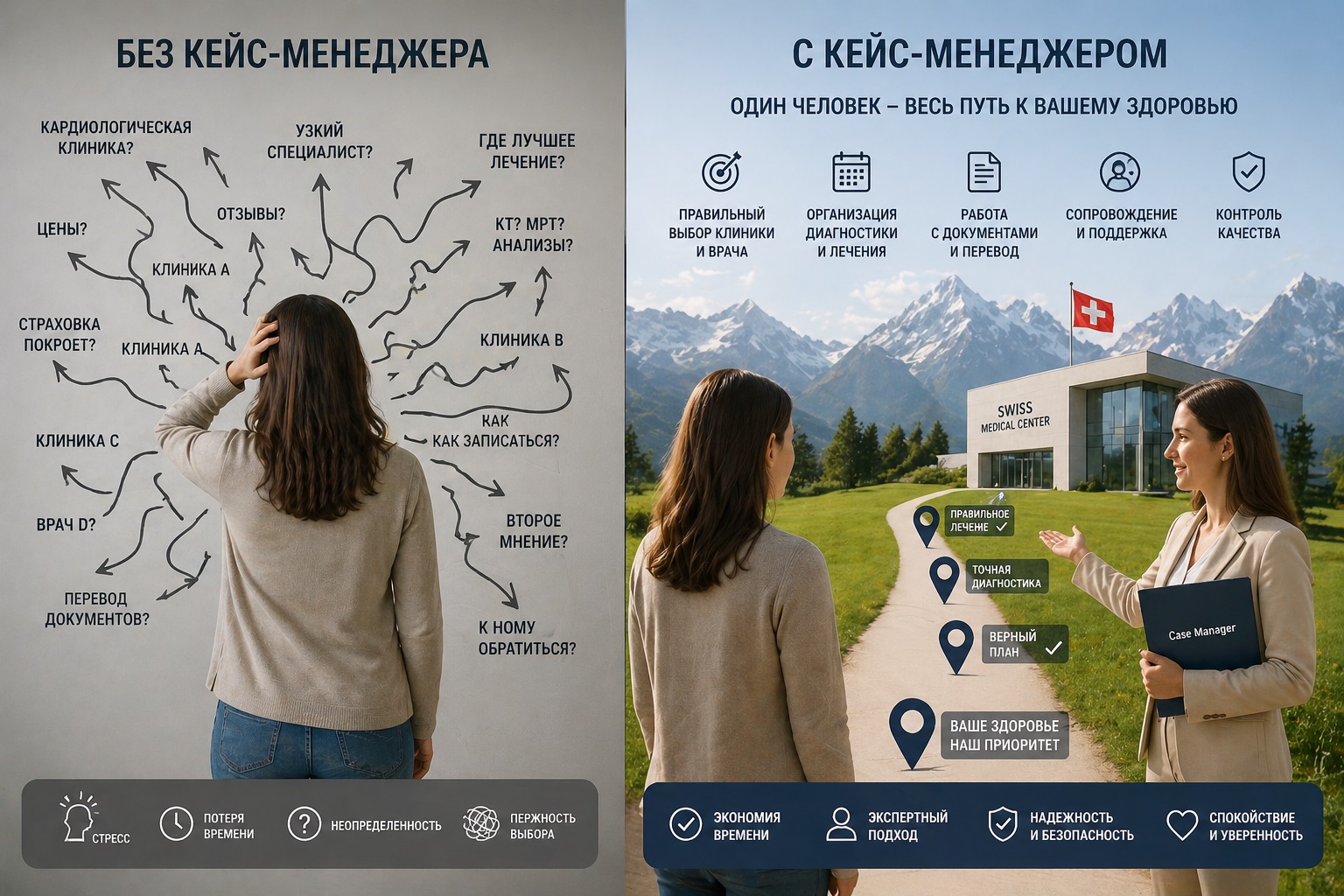
The language barrier adds further complexity. The country uses German, French and Italian, and medical staff do not always speak other languages fluently. Misunderstanding medical information can have serious consequences.
In addition, treatment in Switzerland involves high costs. Any inaccuracy in the organisation — unnecessary tests, the wrong choice of clinic, uncoordinated procedures — has a direct impact on the patient’s budget. A case manager helps avoid these risks.
How working with a case manager works
Cooperation usually begins with an initial enquiry. The patient describes their situation and provides their medical records.
At the next stage, the case manager analyses the information: they study the diagnosis, the medical history and the doctors’ recommendations. If necessary, they may request additional data.
Treatment options are then drawn up. The patient receives several proposals with different clinics and specialists, together with preliminary plans and costs.
Once the right option has been chosen, preparations for the trip begin: paperwork, booking procedures, arranging accommodation and transfers.
During the stay in the country, the case manager accompanies the patient — in person or remotely — helping with any questions that arise and coordinating communication with the clinic.
The work continues after treatment ends: the specialist helps obtain medical reports and recommendations and, if needed, arranges further follow-up.
The advantages of working with a case manager
- Time saved. The patient is spared the work of researching clinics, sending enquiries and comparing options. The case manager takes on these tasks and quickly proposes the best solutions.
- Access to trusted clinics. These specialists work with reliable medical institutions whose quality they are confident in. This reduces risk and increases trust in the treatment.
- Less stress. The patient can focus on their health, free of organisational details. The case manager handles all coordination and communication.
- A transparent process. The person understands the stages of treatment, the timelines and the estimated costs in advance. This helps them make decisions calmly and with clarity.
When you can manage without a case manager
Despite the obvious advantages, in some situations the help of a case manager may be optional.
For example, when it comes to simple medical services — standard examinations or consultations without complex diagnostics.
A case manager may also be unnecessary for repeat visits, when the patient already knows the clinic and the doctor.
Another case is when a person knows their way around the country’s healthcare system, speaks the language and has experience of organising treatment abroad.
How to choose a reliable case manager
When choosing a specialist, it is important to look at their experience and specialisation. Ideally, the case manager should have practical experience in precisely the medical fields relevant to the patient.
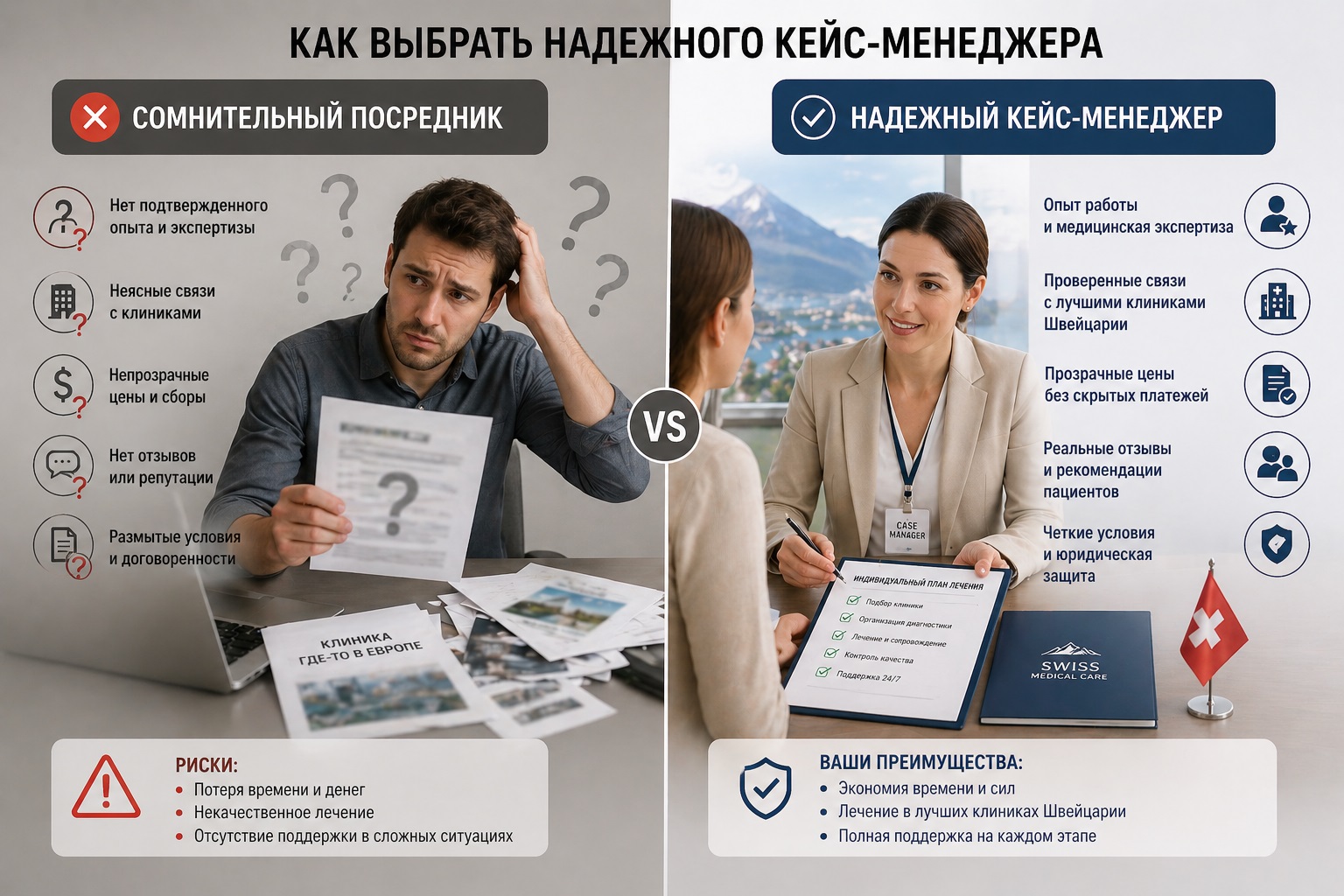
- Reviews and real cases help assess the quality of their work and the level of trust clients place in them.
- Transparent terms are just as important: the patient should understand which services are included in the support and how the cost is calculated.
- Medical expertise is a distinct advantage. It improves the quality of communication with doctors and the accuracy of decision-making.
If you are considering treatment abroad and want the journey to be calm and straightforward, it is important to rely on experienced specialists. A well-structured process saves time, avoids mistakes and lets you focus on what matters most — your health.
CorSwiss offers personal consultations, helps organise diagnostics and treatment, and accompanies patients at leading clinics in Switzerland. This makes the whole journey — from the first enquiry to the completion of therapy — as comfortable and transparent as possible.