Protein homeostasis and its role in ageing and disease
Pierre Goloubinoff: Ageing is a natural and necessary degenerative process of somatic cells that leads to death. Young embryonic, germ and cancer cells are potentially immortal. This is due to their ability to mount massive, optimal defences to protect, repair and replace delicate macromolecules.
How the cell’s system works
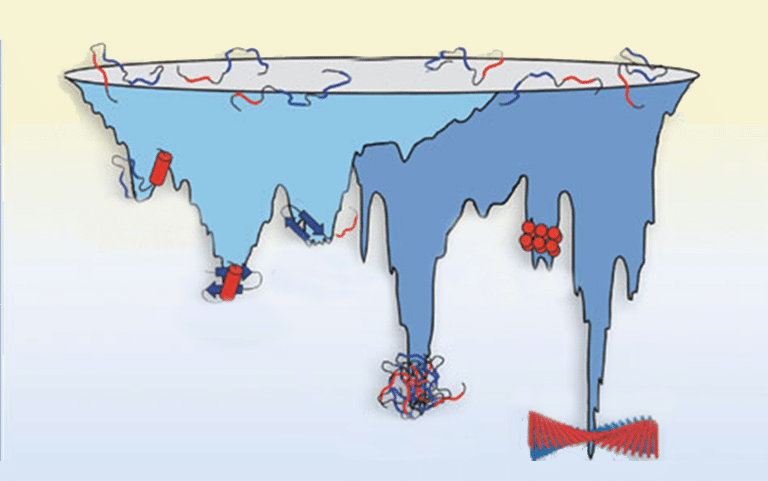
On leaving the ribosomes, new polypeptides must be properly folded, eventually translocated and then assembled into stable yet functionally flexible structures. During their lifetime, proteins are often exposed to stresses such as heat shock, ultraviolet radiation and oxidative stress. This can partially unfold them and convert them into a stably misfolded and aggregated form.
This in turn can damage cells and spread to other cells, as in the case of some prion diseases. In animal cells, especially in ageing neurons, early forms of toxic protein aggregates can accumulate and cause cell death on their way to becoming more compact tangles and amyloids, which are less toxic. In mammals, aggregate toxicity can lead to tissue loss through various mechanisms, including direct membrane damage and reactive oxygen species that alter lipids and signal apoptosis.
Programmed cell death can thus cause an early onset of ageing and of degenerative diseases in general, such as:
- Alzheimer’s disease,
- type 2 diabetes,
- amyotrophic lateral sclerosis,
- Parkinson’s disease,
This ultimately leads to a shorter lifespan.
In youth and in healthy adult life, protein homeostasis and the main cellular mechanisms that effectively manage its quality are:
- Molecular chaperones, acting as holders and as unfolding and folding enzymes.
- Chaperone-gated proteases, acting as aggregate-unfolding and degrading enzymes.
- Aggresomes, acting as aggregate-compacting mechanisms.
- Autophagosomes, acting as aggregate-degrading organelles.
For unclear reasons, these cellular defences gradually become ineffective. Protein homeostasis works less well with age, which leads to degenerative diseases associated with protein misfolding. Understanding these defence mechanisms and the reasons they fail in late adulthood is the key to developing new treatments against degenerative protein-misfolding diseases and ageing.
It has been observed that many cancer cells resemble young cells and are immortal because of their massive overexpression of molecular chaperones, Hsp70 and HSP90 in particular, which can block beneficial apoptosis in response to various radio-, thermo- and chemotherapeutic treatments. Chaperone inhibitors therefore hold promise for increasing the effectiveness of classic treatments against cancerous tissue, provided they can be kept from triggering protein aggregation, degenerative diseases and ageing in healthy tissue.


