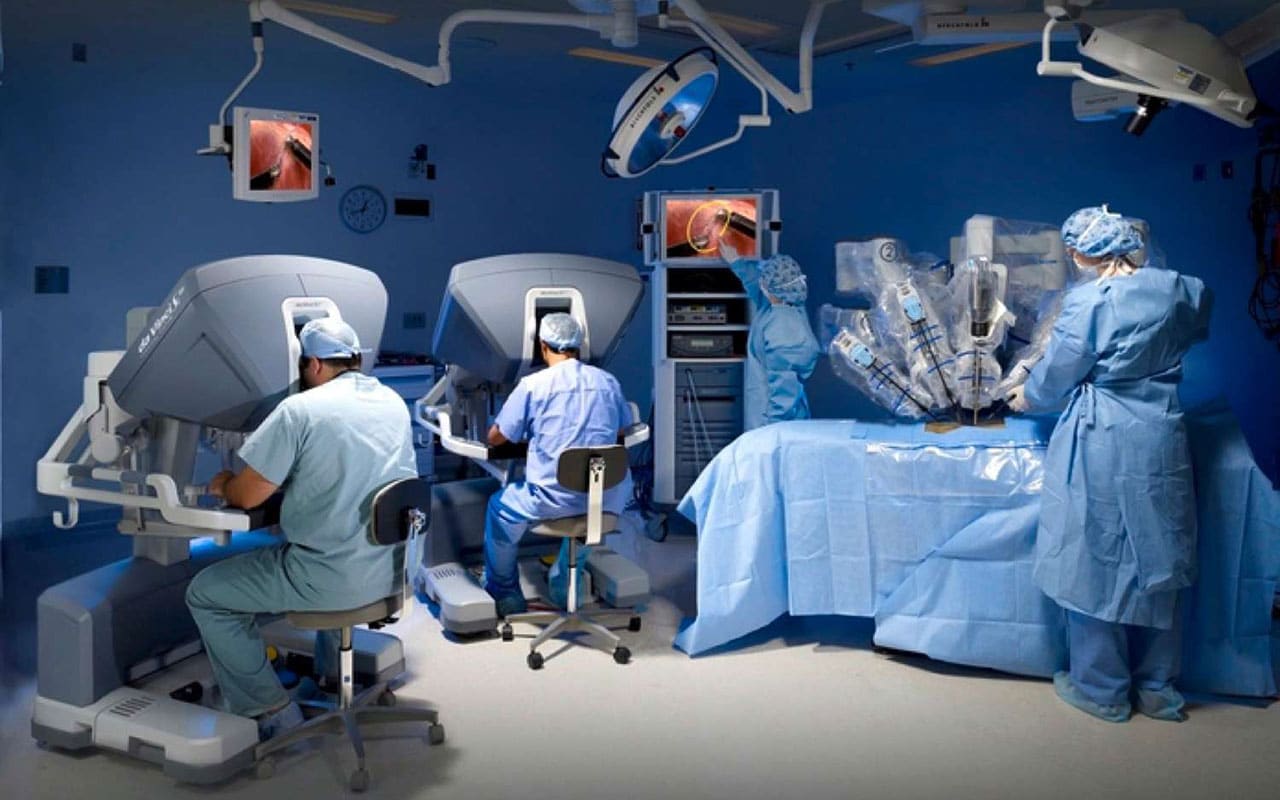
Surgeons today need computerised robotic assistants, and such assistants may arrive in the very near future. The latest generation of medical robots can already do a great deal even without human control. This doctor robot takes over part of the work in the operating theatre.
Martina Bortolani
“Star” is one of the rising technologies in the robotisation of medical services. Recently presented in the United States, the robot sutures soft tissue such as the intestine. What sets it apart from others is its smart program. Once programmed, the autonomous robot (Star) acts as more than an assistant to doctors: it can carry out the assigned program entirely on its own. It sutured so well that its stitches matched those made by surgeons. The robot’s developers are convinced it has a great future.
Doctor Robot “Carlo” – working with bone
“Robots will increasingly take on tasks like these in the future,” says Hans-Florian Zeilhofer, Director of Oral and Maxillofacial Surgery at University Hospital Basel. “Carlo”, for example, is one of the surgical robot models he developed with colleagues from University Hospital Basel and the University of Basel. Just a few months after its development, it was used for the first time in an operation on a small child suffering from a skull deformity.
Using a laser beam, Carlo can cut bone with exceptional precision. “It is far more advanced than a human,” says Zeilhofer. The machine works independently and checks everything with sensors. Carlo can even cut bone in an S-shape. This was unthinkable only a few years ago. It is little wonder that the project won the Swiss MedTech Award 2015 last year.
“Da Vinci” – working with a joystick
The advance of high-tech equipment is now unstoppable. “The advantages of this robot are truly impressive,” says Dr Stefan Bauer of the Urology Centre at Klinik Hirslanden in Zurich. The hospital was one of the first clinics in Switzerland to work with “da Vinci” and now uses the third generation in its operating theatres. Da Vinci technology has existed for more than 10 years.
The four-armed telemanipulator is currently used in urological tumour surgery – in almost 90% of all prostate operations – as well as in kidney and bladder surgery. “We have all come to appreciate the benefits of this technology. Compared with the conventional method (laparoscopy) and ‘open’ surgery, the computer-robot technique is revolutionary,” says urologist Bauer. The organ being operated on can be viewed on a high-definition display at 10× magnification. The surgeon sits at a console next to the patient, controlling the camera with his feet while his hands move joysticks that transmit the direction of movement to the robot’s arms. The robot turns above the patient like a spider. The result is remarkably precise and safe surgery.
“We have drawn on the skills of the Game Boy generation, now that operations are performed with a joystick,” says the urologist. A young surgeon familiar with the mechanics of the console must perform at least 50 procedures before becoming a confident user with good skills. “Robot” courses should be introduced in all medical schools and many major continuing-education centres, and this calls for a clear curriculum. Robotic operations clearly benefit the patient, as the procedure is gentler and less painful.
A patient’s testimonial
I was operated on with the “da Vinci” surgical robot on 26 May 2010. Removal of the prostate and lymph nodes is genuinely very painful, and the larger the incisions made during the operation, the more they hurt. The da Vinci robot made small incisions. The urinary sphincter worked well again immediately after the catheter was removed, and my bladder now empties completely. I advise every patient to choose the “da Vinci” system.
Robots are making their contribution
Today, 3,200 da Vinci machines are in use worldwide, 27 of them in Switzerland. Around 5,000 operations have been performed since 2004.
The development of other computer-assisted surgical systems in Switzerland is in full swing. The start-up KB in Lausanne has developed a spinal manipulator to be used in high-risk procedures.
At the Multi-Scale Robotics Lab at ETH Zurich, researchers are currently working on a micro-robot to be introduced into the body and steered from outside by a magnetic field (MBO).
A high price
Philippe Morel, Head of Visceral Surgery at Geneva University Hospitals (HUG), has performed almost 2,000 operations with “da Vinci” in the 9 years since it was acquired. “The future belongs to da Vinci,” he says, “there is no alternative.” Just as you now read newspapers on a tablet, during operations we will rely on a robot that can translate the surgeon’s hands into precise movements. The cost of these robots is, of course, high – around CHF 2 million – owing to the American manufacturer’s monopoly. On the whole, health insurers support a progressive approach to surgery. The additional costs are borne by the hospital.
Will robots be able to replace humans?
Doctor Robot is precise, reliable and at times more precise than a doctor. Does this mean robots are better than surgeons? No. Even if a large three-dimensional image makes many procedures easier, the whole task is complicated by the absence of touch. Only the doctor can feel living tissue and make decisions during the operation. It may also happen that the robot fails, in which case the doctor can switch immediately to conventional laparoscopy.
This will remain so in the future: “real” surgeons are irreplaceable – even though, given the robot’s extraordinary precision, it may one day come to pass that the human only directs while the robot does the main work.


