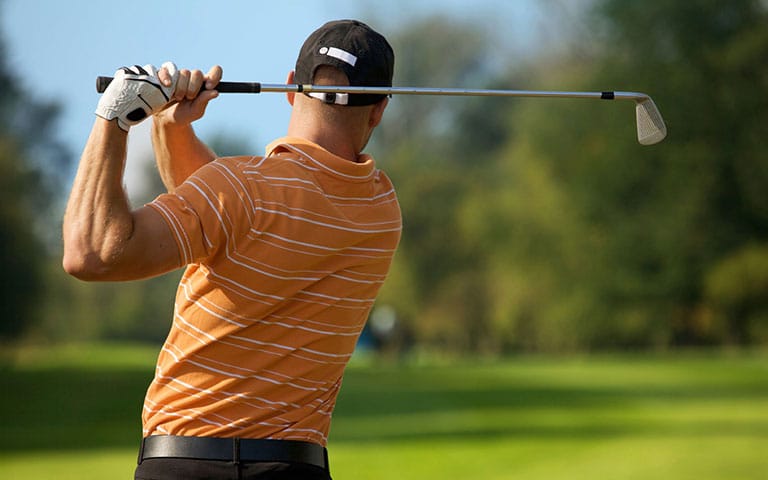
The shoulder consists of four separate joints, which can vary up to 16,000 times. How can you avoid a shoulder injury on the course? How do you achieve maximum mobility and quick reactions in the lever position?
The secret lies in low congruence, which depends largely on how well the soft tissues function. Damage to the tendons – the so-called rotator cuff – can lead to faults in the movement pattern and therefore to inaccurate golf shots, and can even cause pain. Damage and tears in the tendons also encourage faulty movements. Correct use of the legs, spine, trunk and arms is the foundation of a good swing. This requires precise coordination and the synchronisation of different muscle groups.
Yes, golfers often develop shoulder injuries following serious problems with the lumbar spine, because of swing speeds of up to 190 km/h, which place a heavy load on the soft-tissue structures. Good mobility is a prerequisite for acceleration. Restricted rotation of the spine and pelvis forces the shoulder to compensate, which at times leads to insidious injuries of the ligaments and tendons.
To a large extent, these are injuries to the tendons, the bursa of the shoulder joint or the joint capsule. Hitting the ground and abruptly stopping the movement contributes to this. Enormous forces act on the shoulder at that moment, leading to tendon tears and injuries.
A tendon cannot heal on its own, so such injuries often end in surgery to repair the tendons, depending on the type of injury. Nowadays the procedures are small in most cases. Arthroscopic optics make it possible to work inside the joint and to reconstruct and repair damage with millimetre precision.
In every case, the aim is to restore and preserve sporting ability and to reduce pain in everyday life.
Osteoarthritis of the shoulder joint means the loss of joint cartilage, so that the joint no longer works properly. It is the most common disease affecting the joints and their mobility. To restore function, a so-called surface replacement or shoulder joint replacement is carried out.
What matters above all is a careful approach and proper surgical technique, in which the shoulder joint is first fully reconstructed by replacing the gliding surfaces, with the aim of more than simply removing pain. In this case the range of movement is usually almost fully restored.
Yes. After a thorough analysis, the causes that led to the deterioration are addressed. Targeted, specialised medical expertise and jointly defined goals – such as reducing pain or improving range of movement or strength – are the basis for a successful outcome.
Rehabilitation after reconstructive surgery often lasts several months, during which full playing ability is temporarily lost; in many cases, however, patience and professional treatment restore the shoulder’s former function.
An article by Dr. Philipp Frey of the Swiss private clinic Privatklinik Bethanien. Source: Golf Leader magazine.


