Arranging treatment in Switzerland looks simple at first glance: choose a clinic, book a doctor, buy a ticket and travel. In practice, a medical journey is made up of dozens of decisions — from translating documents and finding the right specialist to visa support, the cost estimate, transfers, hospital admission and follow-up care once you are back home.
This is why organising everything yourself often becomes a complex project. The patient needs to know which clinic is genuinely strong in their field, how to reach the right doctor, which documents to send and in which language, how to obtain a medical invitation, when to pay for treatment and what to do if the plan changes after the examinations.
Swiss medicine is highly systematic, and that system rewards precision. The international departments of clinics usually follow a clear sequence: first they review the medical file, then they prepare the doctor’s preliminary opinion, a treatment plan and an individual cost estimate. CorSwiss prepares the medical file, the individual cost estimate and the visa invitation for international patients, and works out the treatment plan, the coordination of appointments and the arrangement of rehabilitation.
Below is the step-by-step sequence by which treatment in Switzerland is usually organised: from the first enquiry to discharge and remote follow-up.
Step 1. Preparation and first contact
The first stage is gathering medical information, well before any tickets are chosen. The more precisely the patient describes the problem, the sooner the clinic can assess the case and propose a suitable specialist.
At this stage it is important to prepare:
- hospital discharge summaries and outpatient reports;
- laboratory results;
- operation reports, if any;
- MRI, CT, ultrasound, PET-CT and endoscopy reports;
- the images themselves on a disc, USB stick or in a digital archive;
- a list of current medications;
- a brief description of complaints, symptoms and the purpose of the enquiry.
A common mistake is to send only an informal description: “my back hurts”, “I need heart surgery”, “a suspected tumour”. A clinic needs more than this. The doctor must see the medical history, the trend in test results, the imaging findings and any treatment already carried out.
Ideally, documents should be translated in advance into German, French, Italian or English. Switzerland has several national languages, and a clinic’s working language depends on the canton: German is most common in Zurich and Basel, French in Geneva and Lausanne, and Italian in Ticino. English is widely used in international departments, yet a translation may still be required for medical reports and visa documents.
The patient or a medical coordinator then sends the enquiry to the clinic. A good enquiry includes the diagnosis or presumed problem, the purpose of the trip, preferred dates, the patient’s age, the documents and the question for the doctor — diagnostics, a second opinion, surgery, rehabilitation or comprehensive treatment.
Step 2. Choosing the clinic and the doctor
Switzerland is strong in many fields: oncology, cardiology, orthopaedics, neurosurgery, rehabilitation, reproductive medicine, check-up programmes, childbirth and plastic surgery. The best clinic overall, however, is not always the best one for your particular case.
When choosing, it is worth considering:
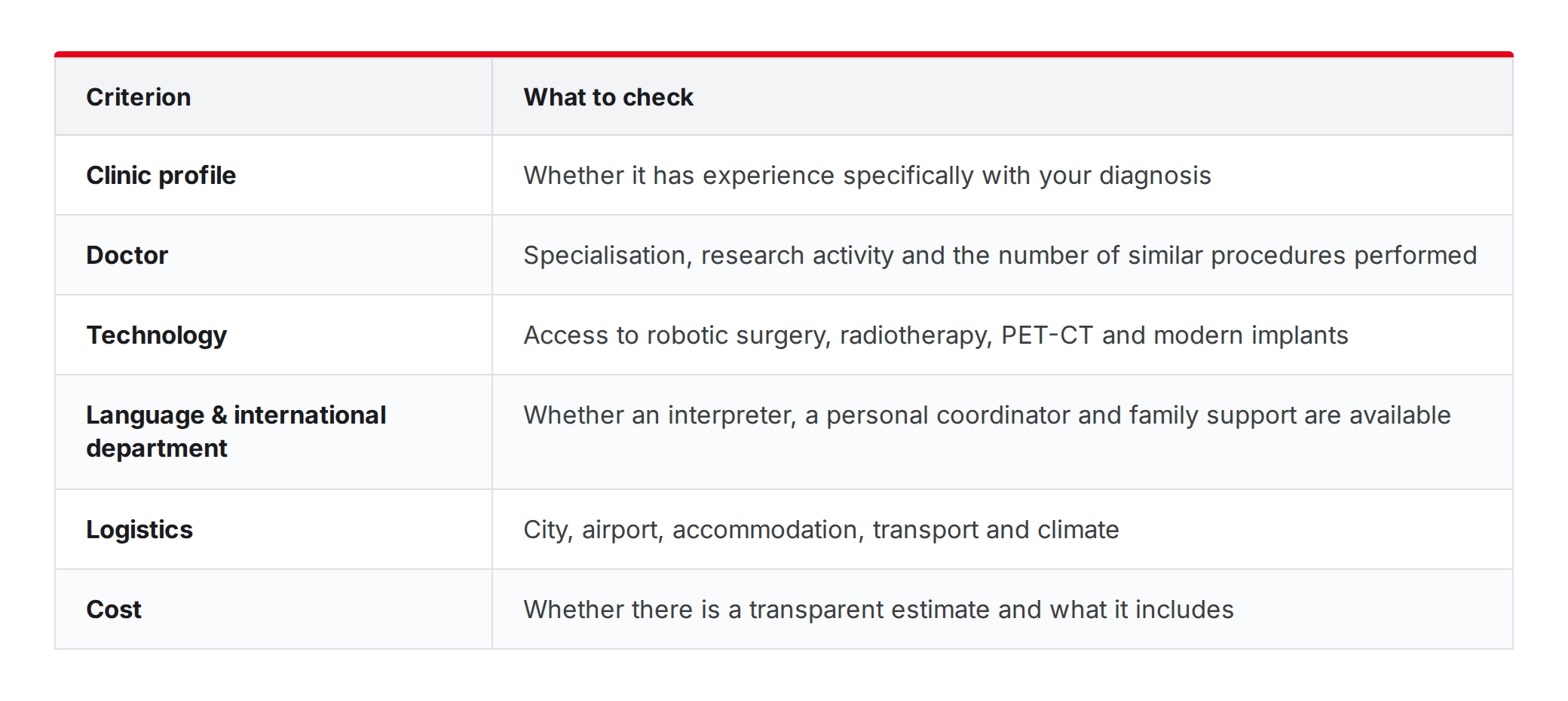
A university hospital may be the best choice for a rare diagnosis or complex oncology. A private clinic suits planned surgery, rehabilitation, childbirth, orthopaedics or a check-up, where comfort, speed and personal support matter. Sometimes the ideal option is a combination: diagnostics at one centre, surgery with a specific surgeon and rehabilitation at a specialised clinic.
Step 3. Medical assessment and preliminary plan
Once the file is complete, the clinic passes it to the doctor or the specialist team. At this stage the specialist assesses whether there is enough information for a preliminary opinion. If data is limited, the patient may be asked for additional tests or invited to undergo diagnostics in Switzerland first.
In most Swiss clinics, the initial cost estimate is calculated by specialists on the basis of the documents and information the patient sends in advance. The more medical data provided before the trip, the more realistic the calculation. This matters: Swiss clinics prefer facts to “approximate promises”.
The medical assessment usually includes:
- a preliminary medical opinion;
- a recommendation on further diagnostics;
- a treatment or surgical plan;
- the estimated length of stay;
- whether hospital admission is required;
- the outlook for rehabilitation;
- a preliminary cost.
For diagnostics, the plan can be ready quickly. For complex cases — for example oncology, repeat surgery, cardiac surgery or neurosurgery — preparation takes longer, as several specialists review the documents.
Step 4. Cost estimate and financial terms
After the medical assessment, the patient receives a cost estimate. Ideally, this is a structured document rather than a single figure: consultations, diagnostics, surgery, anaesthesia, room, meals, medication, doctors’ fees, rehabilitation, interpreter, transfers and accommodation for an accompanying person.
It is important to clarify in advance what is included and what is charged separately. Additional costs may arise, for example, for:
- urgent tests and imaging;
- biopsy and histology;
- implants and consumables;
- additional days in hospital;
- medication after discharge;
- rehabilitation;
- accommodation for an accompanying person;
- an interpreter outside the clinic.
In Swiss clinics, the full amount of the offer usually has to be paid no later than the day of arrival. A full or partial refund of the deposit is also common practice if the final invoice turns out lower than the preliminary amount.
This is standard practice: the clinic reserves the operating theatre, room, doctors and equipment, so advance payment is often required for planned treatment. The final amount may change, however, if the examinations show that the scope of treatment needs to be adjusted.
Step 5. Visa, invitation and travel documents
For short-term treatment, a Schengen type C visa is usually issued. If treatment or rehabilitation involves a longer stay, a national type D visa may be required. The exact type depends on the patient’s nationality, the length of treatment and the consulate’s requirements.
Official visa requirements are best checked on the website of the Swiss Federal Department of Foreign Affairs or with the consulate where the application is submitted. For a medical visa, the patient usually needs:
- a completed visa application form;
- a passport;
- photographs;
- travel medical insurance valid for the Schengen Area;
- an invitation from the clinic or hospital;
- confirmation of payment or deposit;
- proof of financial means;
- tickets or a transport reservation;
- proof of accommodation.
The Swiss embassy’s visa checklist for medical treatment specifically states that an invitation from the clinic or hospital, signed by a doctor and confirming the deposit for medical services, is required. The insurance must also be valid for the entire stay and cover at least EUR 30,000 for emergency care, hospitalisation and repatriation.
An accompanying person also needs documents: a visa, insurance, proof of accommodation and a letter from the clinic if the trip involves accompanying the patient.
Step 6. Organising logistics
Once the treatment plan, cost estimate and visa matters are agreed, the practical part begins: dates, flights, transfers, accommodation, interpreter and the schedule of appointments.
Many international departments help with transfers, hotels and personal support. Additional services may include medical transport, hotel and apartment bookings for relatives, taxi or limousine service, and written and interpreting services.
Logistics matter especially for serious conditions. After surgery, a patient may need to avoid sitting for long periods, lifting luggage, moving about unaided or changing transport. This is why both the arrival and the return journey are planned in advance: whether a wheelchair is needed at the airport, a medical transfer, a nurse escort, an extra seat on the plane, or approval to carry medication.
Step 7. Arrival, consultation and further diagnostics
After arriving, the patient attends a first in-person consultation. Even if the documents were reviewed in advance, the Swiss doctor needs to confirm the diagnosis in person. This stage includes an examination, a review of the medical history, a discussion of complaints and the planning of further investigations.
Further diagnostics may include:
- laboratory tests;
- MRI, CT, ultrasound, PET-CT;
- consultations with specialists in related fields;
- a cardiac assessment before anaesthesia;
- an anaesthetic consultation;
- a repeat biopsy or a review of histology.
For check-up programmes, it is usually recommended to book at least two weeks ahead so that every stage can be arranged around the patient’s specific needs. In Swiss clinics, a check-up is typically built on three blocks: specialist consultations, laboratory tests and instrumental diagnostics; the programme is generally completed within 1–3 days.
Step 8. Treatment and hospital stay
Once the diagnosis is confirmed, treatment begins. This may be surgery, drug therapy, radiotherapy, an image-guided procedure, an endoscopic intervention or a rehabilitation programme.
Before surgery, the patient usually has a consultation with the anaesthetist and signs an informed consent form. Private clinics explain in detail what will happen before, during and after the procedure. As a rule, on admission the patient receives documents stating the date and time of the anaesthetic consultation or admission to the clinic, together with an anaesthesia questionnaire.
During the hospital stay, the patient is monitored regularly. Depending on the procedure, the plan includes dressing changes, follow-up tests, pain management, physiotherapy, doctor’s consultations and preparation for discharge. Switzerland places great emphasis on post-operative recovery as well as on the operation itself: early mobilisation, prevention of complications, pain control and clear recommendations.
Step 9. Discharge, rehabilitation and remote follow-up
Treatment continues beyond the day of discharge. The patient receives a medical report, a list of prescriptions and recommendations on lifestyle, restrictions, flying, physical activity and further follow-up. If rehabilitation is needed, it can be arranged at a specialised Swiss centre or after returning home.
After discharge, it is important to receive:
- the doctor’s final report;
- the results of all examinations;
- the operation report;
- recommendations on medication;
- a rehabilitation plan;
- the schedule of follow-up examinations;
- contact details for remote communication;
- documents for the insurance company, if required.
Many questions after returning home can be handled online: sending test results, adjusting therapy, discussing recovery or requesting a second opinion. This is especially important for oncology, cardiology, orthopaedic and neurology patients.
Ways to organise treatment
There are three main scenarios:
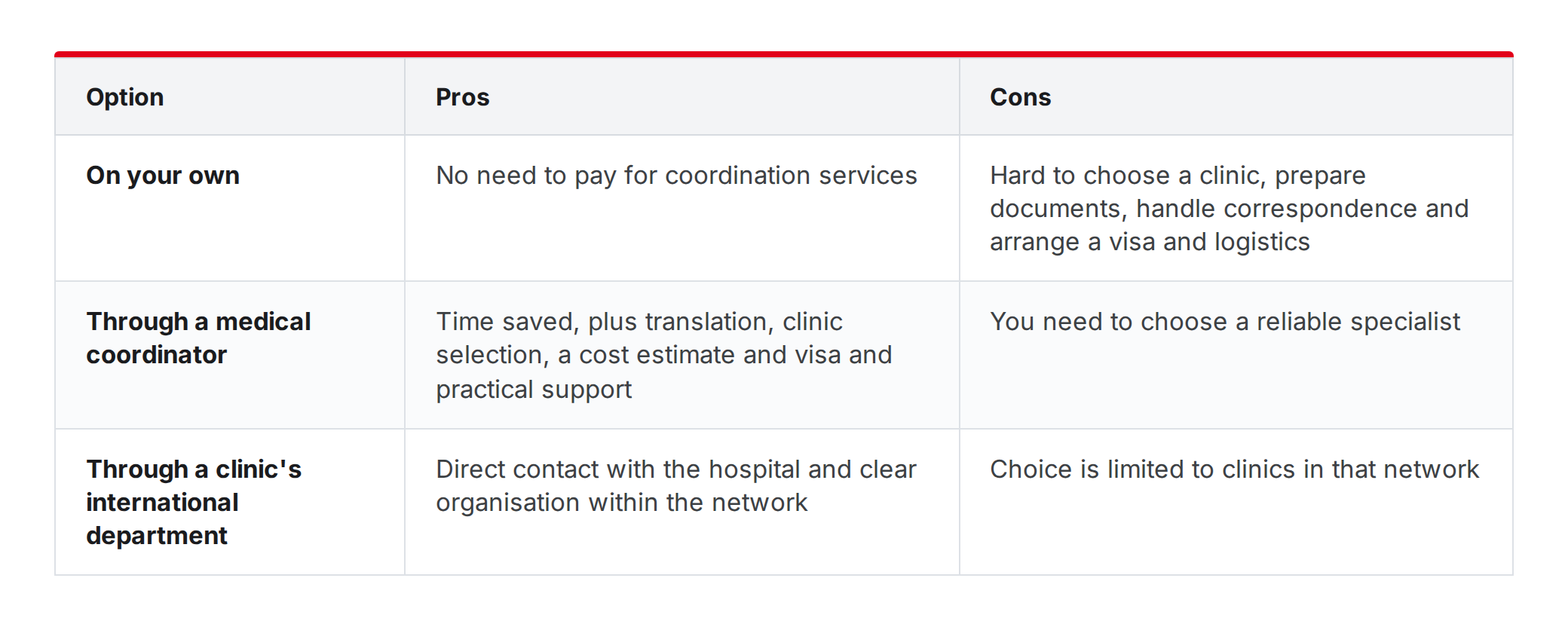
Organising everything yourself suits patients who speak the language well, understand the healthcare system and are prepared to handle the correspondence and compare clinics. A coordinator is valuable when the case is complex, when time is short, or when document translation, several opinions or support for the patient’s family are needed.
Common mistakes
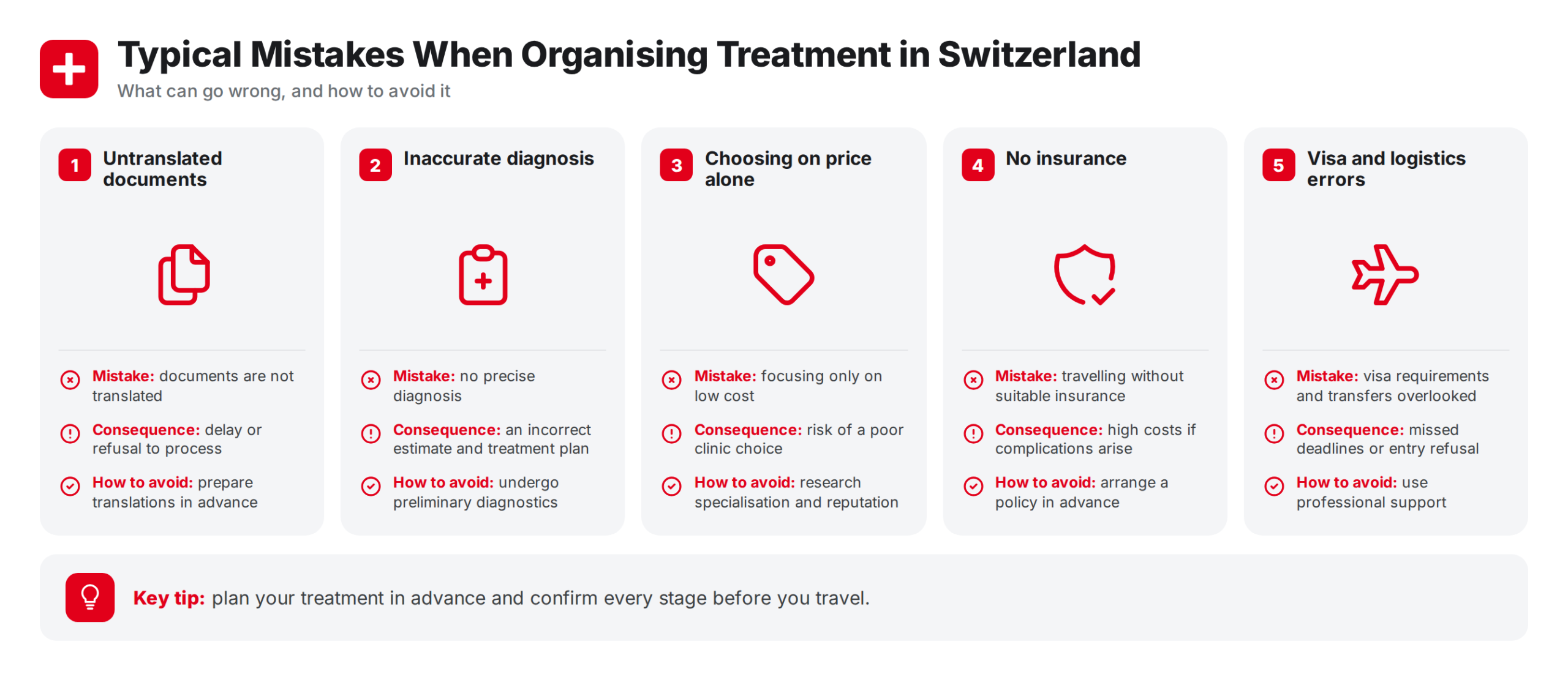
The most frequent mistakes when organising treatment:
- Sending an incomplete set of documents and receiving an inaccurate cost estimate.
- Choosing a clinic on price alone rather than on the doctor’s experience.
- Failing to check whether medication, implants and rehabilitation are included in the cost.
- Taking out standard travel insurance that does not cover medical risks.
- Buying tickets before the appointment date is confirmed.
- Leaving the accompanying person unprepared for visa and living costs.
- Returning home without a follow-up plan.
Careful organisation reduces the risk of unpleasant surprises: the patient knows the route, cost, timeline, documents and the role of everyone involved from the outset.
FAQ
How long does it take to organise treatment?
Usually two to four weeks, provided the documents are ready. Urgent cases can be reviewed faster, but visa processing times and the doctor’s availability still need to be taken into account.
Do I need to speak the language?
Not necessarily. Many clinics work with international patients and interpreters. Medical documents, however, are best prepared in English, German, French or Italian.
Can I come with an accompanying person?
Yes. In Swiss clinics, an accompanying person can usually stay in the patient’s room or in a separate room or suite, where available. Terms and costs should be confirmed in advance.
When do I need to pay?
For planned treatment, advance payment or payment before the day of arrival is often required. After the final invoice, either an additional payment or a partial refund of the deposit may follow, if actual costs turned out lower.
Does insurance cover treatment?
Compulsory health insurance applies to residents of Switzerland. The Swiss Federal Office of Public Health states that anyone who takes up residence in the country must take out insurance within three months. For medical travellers, planned treatment is more often paid privately or through an international insurance company.