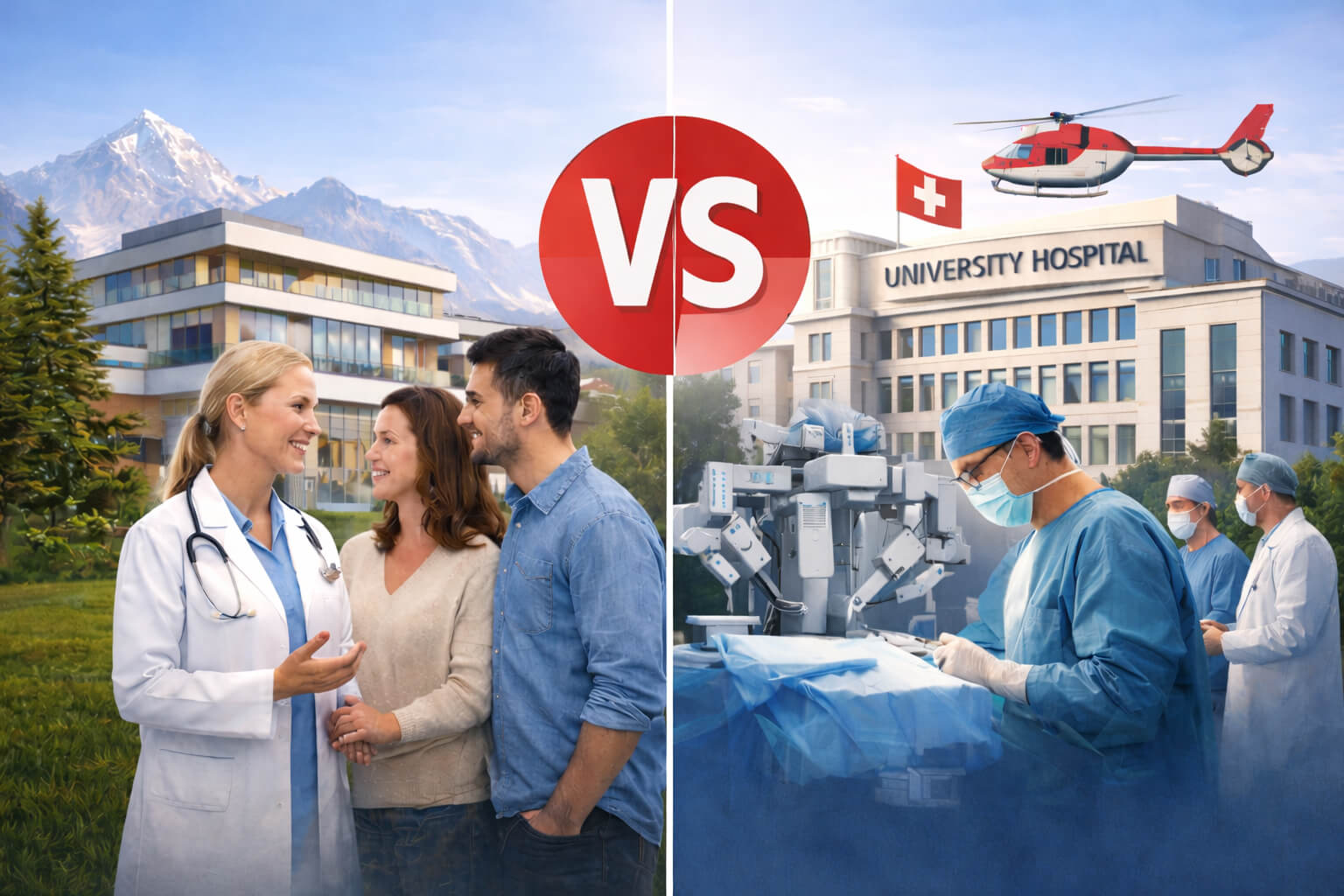
Both private and public clinics in Switzerland offer a high standard of medicine, modern technology and highly qualified doctors. The main difference lies in how treatment is organised, how quickly patients can see a specialist and the level of service. Public hospitals often serve as large medical and research centres, while private clinics focus on an individual approach and patient comfort. This is why international patients often choose private medical institutions.
How the Swiss healthcare system works
The Swiss healthcare system is regarded as one of the most advanced in Europe. It combines public medical institutions, private clinics and a system of compulsory health insurance.
The system rests on:
- public hospitals
- private clinics
- compulsory health insurance for residents
- strict standards of medical care
Most residents receive treatment through the compulsory health insurance system. Patients can go to public institutions as well as to certain private clinics that work with insurance schemes.
The high standard of medical care in Switzerland is ensured by strict treatment standards, a strong scientific base and the continuous adoption of modern technology.
Public clinics in Switzerland
The role of university and cantonal hospitals
Public medicine in Switzerland is represented above all by cantonal hospitals and university medical centres. These institutions play a key role in the country’s healthcare system.
Major university hospitals, such as University Hospital Zurich, are affiliated with the country’s leading universities and fulfil several important functions:
- treating patients
- conducting medical research
- training future doctors
These hospitals often become centres for developing new methods of diagnosis and therapy.
Access to treatment for residents
Public hospitals are primarily geared towards residents of Switzerland. They operate within the insurance system and treat patients who hold health insurance.
Typical features of these institutions include:
- treatment according to established medical protocols
- a heavy workload for doctors
- possible waiting lists for planned procedures
- priority for patients resident in Switzerland
The standard of medical care nevertheless remains very high. Public clinics are particularly strong in complex surgery, transplant medicine and cardiology.
Research and medical training
Many university clinics in Switzerland take an active part in international research. They also play a key role in training doctors.
The European association of medical universities notes:
“Academic medical centres play a key role in advancing medical innovation and training specialists.”
This explains why university hospitals remain important research centres of European medicine.
Private clinics in Switzerland
Specialised medical centres
Private clinics in Switzerland often operate as specialised medical centres. Many of them concentrate on particular fields of medicine.
The most common specialisations are:
- oncology
- orthopaedics
- cardiology
- neurosurgery
- rehabilitation medicine
- aesthetic and reconstructive surgery
This specialisation allows doctors to concentrate their expertise in particular areas and to use the latest medical technology.
A high level of medical service
One of the main advantages of private clinics is the way their medical service is organised. These institutions place great emphasis on patient comfort and the coordination of treatment.
Private clinics usually offer:
- a personal treatment coordinator
- help with translating medical documents
- personal support for international patients
- individual treatment planning
For patients travelling from abroad, this system makes organising treatment much simpler.
An individual approach to each patient
Private clinics place great emphasis on a personalised approach. The treatment plan is often shaped around the patient’s individual characteristics.
This approach is particularly important in the treatment of complex conditions, including cancer and rare diseases.
Modern equipment and technology
Private medical centres invest actively in new medical technology. This allows them to introduce innovative methods of diagnosis and treatment.
Clinics may use:
- robotic surgical systems
- advanced medical imaging
- genetic testing
- innovative therapies
This high level of technological equipment is one of the reasons Switzerland is regarded as a centre of international medical travel.
The main differences between private and public clinics
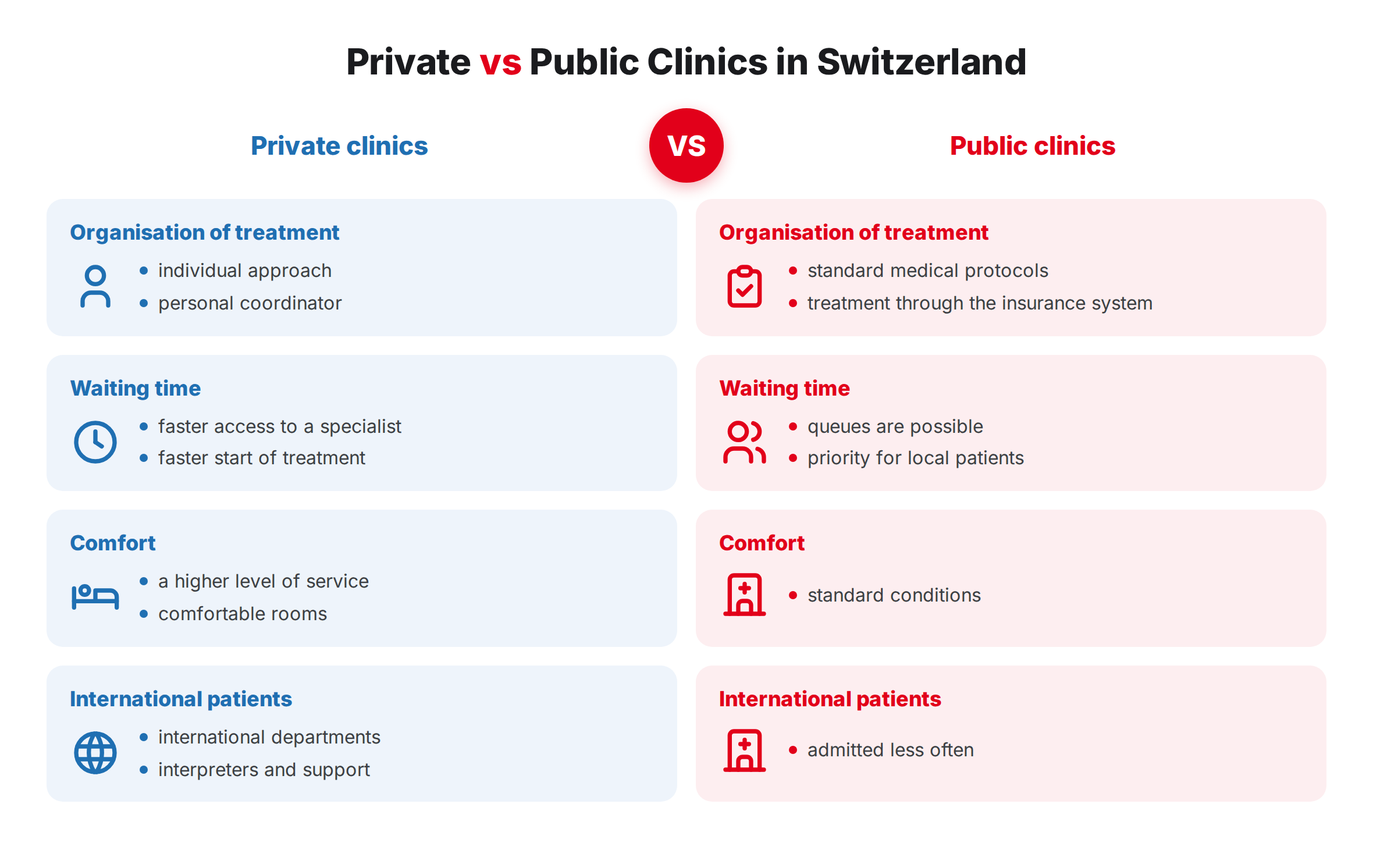
Although the standard of medicine is equally high, private and public clinics differ in how they are organised.
Level of service
Public hospitals follow a standard model of medical care. Private clinics usually offer a higher level of service, including personal support for the patient and individually organised treatment.
Waiting times
Public hospitals may have waiting lists for planned procedures. In private clinics, treatment often begins sooner thanks to more flexible organisation.
Accommodation
In public hospitals, accommodation meets standard hospital requirements. Private clinics more often offer more comfortable accommodation.
Access for international patients
Public clinics primarily serve residents of Switzerland. Private medical institutions more often accept international patients and have international departments.
Cost of treatment
Public hospitals operate within the insurance system. Private clinics usually provide treatment on a self-pay basis.
Access to treatment for international patients
Switzerland has long been a destination for international medical travel. Patients come here for diagnostics, for treatment of complex conditions and for a second medical opinion.
International patients are more often accepted by private clinics, as these institutions have experience in working with patients from abroad.
Private clinics usually offer:
- international departments
- medical coordinators
- interpreters
- help with travel arrangements
Organising treatment usually involves several stages:
- sending medical documents
- receiving a preliminary medical opinion
- receiving a cost estimate for treatment
- planning the trip
When patients choose private clinics
In many cases, patients prefer private medical institutions.
The most common situations are:
- complex or rare conditions
- the need for personalised treatment
- seeking a second medical opinion
- faster access to specialists
- a high level of comfort and service
For international patients, another important factor is the ability to arrange treatment promptly.
When treatment may take place in public clinics
Private medical centres are popular, and public hospitals remain an important part of the healthcare system as well.
Treatment may take place in these institutions if:
- the condition is treated according to standard medical protocols
- the patient is taking part in a research programme
- the expertise of a university medical centre is required
- treatment is provided within the insurance system
In many cases, university hospitals are the leading centres of academic medicine.
How to choose a clinic for treatment in Switzerland
The choice of medical institution depends on the diagnosis, the specialists’ recommendations and the patient’s goals.
The process usually involves several stages:
- choosing a clinic and a doctor
- sending medical documents
- receiving a preliminary medical opinion
- receiving a cost estimate for treatment
- arranging the trip
For international patients, this process can be complex. This is why many turn to medical coordinators.
The CorSwiss service, for example, helps patients choose a clinic, arranges specialist consultations and provides personal support throughout treatment in Switzerland.
Both public and private clinics in Switzerland offer a high standard of medicine and modern treatment technology. Public hospitals play an important role in research and in training doctors.
For international patients and complex medical cases, however, private clinics often prove the more convenient option. Prompt organisation of treatment, an individual approach and well-developed patient support make them a popular choice for people considering treatment in Switzerland.
FAQ
How do private and public clinics in Switzerland differ?
The main difference lies in how treatment is organised. Public hospitals operate within the insurance system and are geared towards residents of Switzerland. Private clinics more often offer an individual service and actively welcome international patients.
Where is it best for international patients to be treated?
International patients more often choose private clinics, as these institutions have international departments, medical coordinators and experience in working with patients from many countries.
Does the quality of treatment differ?
The quality of medical care remains high in both systems. The main difference lies in the level of service, the speed with which treatment is organised and the standard of accommodation.
How much does treatment in a private Swiss clinic cost?
The cost of treatment depends on the diagnosis, the clinic and the scope of medical care. Private clinics usually work on a self-pay basis and sit outside the public insurance system.
Can a foreign national be treated in a public clinic in Switzerland?
Yes, this is possible. These clinics, however, primarily serve residents of Switzerland, so international patients more often turn to private medical centres.