
Treatment abroad almost always begins with a question rather than a flight: whom to contact, how to arrange everything and what will happen next. For an international patient, a trip to a Swiss clinic is a sequence of steps along a single route, where medical precision, clear communication and well-planned logistics all matter.
In practice, the journey becomes far calmer when the patient understands the stages of the process from the outset and has personal support along the way. This is why many turn to specialised medical coordinators such as CorSwiss, who help to plan the route from the first enquiry to the return home.
1. The first enquiry: where it all begins
The first stage is an enquiry from the patient or their family to a clinic or a medical coordinator. At this point, the person usually already knows about their problem, their diagnosis or at least the symptoms that need clarification and treatment.
The first enquiry usually contains the essentials: the patient’s age, a brief description of the diagnosis or complaints, any examinations already carried out and the purpose of the request. For some it is a second opinion; for others, a precise diagnosis, surgery, cancer treatment, rehabilitation or a comprehensive check-up.
This is where the first contact is made, and it sets the tone for the entire process. The more precise and clear the request, the sooner the next step can follow.
2. Gathering and translating medical records
After the initial enquiry, the patient is asked to provide their medical records. These are typically discharge summaries, test results, doctors’ reports, CT, MRI or X-ray images and sometimes details of previous treatment.
For a Swiss clinic, completeness matters, and so does ease of review. The medical records therefore need to be organised: the key reports set apart, current examination results prepared and, where necessary, a professional translation arranged.
This stage may seem purely technical, yet it largely determines how quickly the clinic can reach a decision. When the documents are compiled correctly, the doctor can assess the situation faster and propose a clear plan.
3. The doctor’s preliminary opinion and choice of clinic
Once the documents are ready, they are passed to the relevant specialist for review. At this stage, the patient receives a preliminary medical opinion: confirmation of the diagnosis, possible treatment options, any need for further examinations and recommendations on the format of the visit.
Sometimes the initial review already makes it clear which clinic, department or specialist is the best fit. In other cases, the patient may be offered several options – depending, for example, on urgency, specialisation or the desired level of service.
For the patient, this is one of the most important stages. It brings clarity: whether travelling to Switzerland is truly worthwhile, how appropriate treatment at the chosen clinic is and what to expect from the forthcoming trip.
4. Cost estimate and agreeing the treatment plan
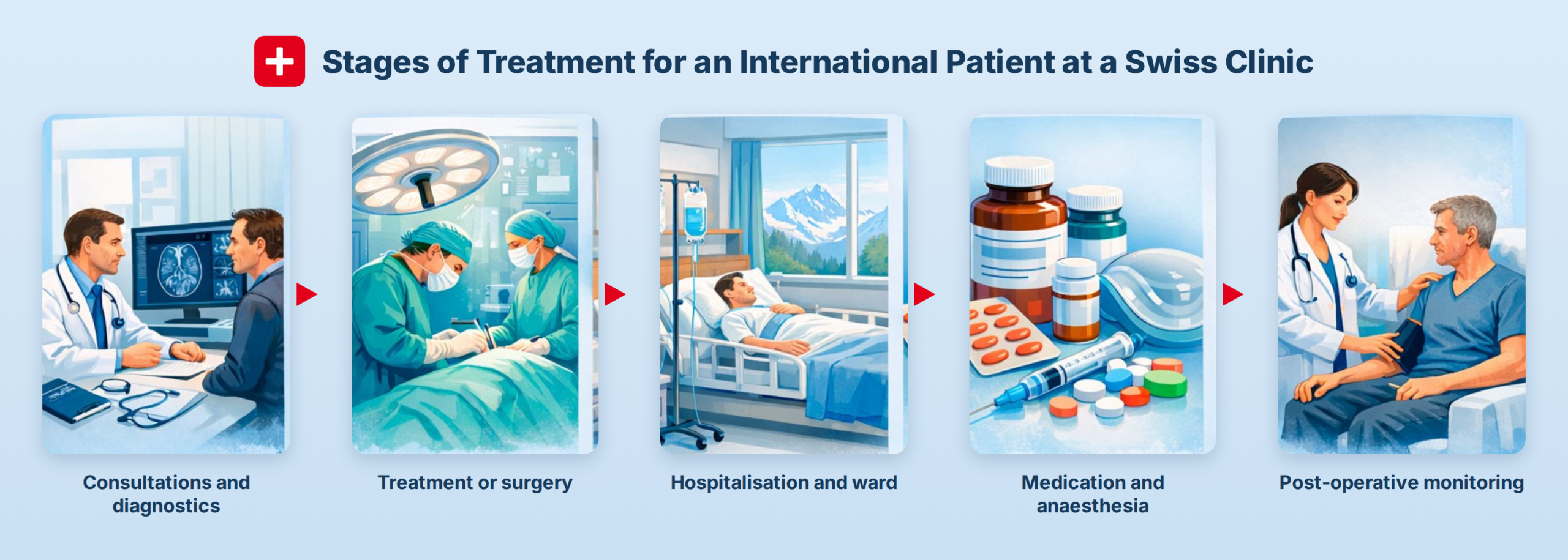
After the preliminary medical assessment, the patient usually receives an outline treatment plan and a preliminary cost estimate. This may cover specialist consultations, diagnostics, hospitalisation, surgery, anaesthesia, the room, medication and follow-up care.
In international medicine, a transparent budget is of great importance. The patient needs to know in advance both the approximate cost and how it is made up. This supports a considered decision and allows financial preparation free of unnecessary stress.
At the same stage, the dates of the trip, the length of stay and the expected form of treatment are agreed: an outpatient visit, a short hospital stay or longer-term medical support.
5. Visa and travel preparation
Once the medical plan is confirmed, the organisational part begins. If the patient needs a visa, documents are prepared confirming the purpose of the trip, the treatment dates and the clinic’s invitation. At the same time, flights, transfers, accommodation for accompanying persons and practical logistics on site are arranged.
Many patients feel most uneasy about this stage, because it involves a great many practical details rather than medicine. With skilled coordination, however, the entire route can be planned in advance: from the arrival date to the airport transfer and accommodation close to the clinic.
The better this stage is prepared, the more at ease the patient feels on arrival. Their energy stays free for what matters most – their health – while the organisational details are taken care of.
6. Arrival in Switzerland and the first days at the clinic
After arrival, the in-person part of the journey begins. The first days usually include initial consultations, additional examinations and final confirmation of the treatment plan. Even when much has already been agreed remotely, an in-person assessment remains an essential part of the process.
For an international patient, comfort, clear communication and a sense of control over what is happening are especially important. Clear organisation is therefore highly valued at this stage: a known consultation schedule, clarity about who is accompanying the patient and how quickly questions can be answered.
It is during these first days that the patient settles into the new environment and begins to see the trip as a well-managed medical process with a clear course.
7. Diagnostics and treatment
The main stage is the diagnostics and the treatment itself. Depending on the case, this may be a targeted examination, a surgical procedure, an oncology protocol, cardiac treatment, orthopaedic surgery or a rehabilitation programme.
Swiss clinics usually organise the process so that the patient understands what is happening and why. The doctor explains the aims of each stage, the expected results and any possible limitations. This is especially important in an unfamiliar country, where trust depends directly on transparent communication, safe treatment and continuity of care.
If new findings emerge during diagnostics, the plan may be adjusted. Such changes are generally discussed in advance, so that the patient and their family understand the medical reasoning behind the decisions.
8. Discharge and recommendations before departure

Treatment continues beyond the moment of discharge. Before returning home, the patient receives a medical report, recovery recommendations, a list of medications, instructions for monitoring their condition and, where necessary, a schedule of further consultations.
This is the key transition between treatment at the clinic and recovery at home. It is very important that the patient has all the documents to hand: the discharge summary, examination results, prescriptions and recommendations on lifestyle and further monitoring.
If the patient is to continue therapy at home, the Swiss team usually sets out exactly which steps to take after returning and what to pay particular attention to in the following weeks or months.
9. Returning home
Returning home opens a new chapter of the story, in which stability, following the recommendations and monitoring one’s wellbeing come to the fore. After intensive treatment or surgery, the patient may need a gentle regime, monitoring by a local doctor and regular contact with the clinic.
At this stage, careful preparation in advance is especially valuable. When the patient understands which symptoms are normal, when to seek advice urgently and how contact with the treating team is organised, the adjustment after the trip is far calmer.
For the patient’s family, too, this is an important moment: the return home becomes a clear continuation of a treatment route that has already been mapped out.
10. Remote follow-up after treatment
Today’s patient journey often includes remote follow-up care. After returning home, there may be online consultations, reviews of test results, assessment of recovery progress and adjustments to the recommendations.
This format is especially important for international patients, as it maintains the connection with the treating specialist without an immediate return trip. The patient continues along a clear plan, with the specialist at their side.
This is why the journey to a Swiss clinic today is a structured process rather than a one-off trip, with each stage linked to the one before and the one after.
FAQ
How long does it take to arrange treatment in Switzerland?
On average, anything from a few days to a few weeks passes between the first enquiry and the trip. The timeframe depends on the urgency of the case, the readiness of the medical records and how quickly the treatment plan is agreed.
Do I need to come to Switzerland for an initial consultation?
Not always. In many cases, a doctor’s initial opinion can be obtained remotely, based on the medical records. An in-person visit is required for diagnostics or treatment.
Which documents should I prepare in advance?
Discharge summaries, test results, doctors’ reports and imaging (CT, MRI, X-ray) are usually required. The documents should be up to date and, where necessary, translated.
How is the cost of treatment calculated?
The cost is determined individually and depends on the diagnosis, the scope of diagnostics, the type of treatment and the length of stay. A preliminary plan and cost estimate are agreed before the trip.
Is help available with the visa and travel arrangements?
Yes. As a rule, the clinic or medical coordinator helps to prepare the visa documents and arranges flights, transfers and accommodation.
What happens after I return home?
The patient continues their recovery according to the doctor’s recommendations and can stay in contact with the clinic. Online consultations and monitoring of their condition are often part of the arrangement.
Will I need to return to Switzerland after treatment?
That depends on the individual case. In many situations, further monitoring can take place remotely, with no need for a second trip.
Can I obtain a second medical opinion without treatment?
Yes. Many patients come specifically for a second opinion, to confirm a diagnosis or clarify a treatment plan before travelling to a clinic.
Who accompanies the patient during treatment?
The patient may be accompanied by the clinic’s international department or by a specialised medical coordinator, who helps at every stage – from the first enquiry to the return home.