
Clinical trials in Switzerland are a strictly regulated medical process that often gives patients access to new treatments before they become standard care. For many patients, particularly those with cancer or rare diseases, taking part in a trial can be a genuine therapeutic option.
Let us look at this step by step and in full detail:
- How to join a trial
- Who makes the decision
- How safe it is
What a clinical trial is in practice
A clinical trial is the stage at which new treatments, medicines or technologies are tested with the participation of patients. In Switzerland, such trials take place only after a rigorous prior assessment and are governed by law and by independent bodies.
It is important to understand that no patient enters a trial by chance. Every trial protocol clearly sets out:
- who may be enrolled;
- which criteria exclude participation;
- which procedures will be carried out;
- the risks and the expected effects.
What this means for the patient
Joining a trial is a matter of eligibility rather than choice: you either meet its criteria or you do not. The main focus is therefore on finding a trial that matches your specific clinical case.
Who decides on participation
The decision to enrol a patient is taken by a team working within the trial protocol, rather than by a single doctor. Approval by an independent ethics committee is also a mandatory step.
In Switzerland, trials are overseen by bodies including Swissmedic, which is responsible for the safety of medicines and medical technologies.
Even if a doctor considers you a suitable candidate, the final decision depends on meeting every criterion of the protocol. This protects the patient from unjustified enrolment.
How to obtain approval to take part
The process always begins with an assessment. The patient or their doctor submits the medical records, after which the trial team checks whether the criteria are met.
In practice, the path looks like this: first a suitable trial is identified, then a complete set of documents is compiled, and a preliminary assessment follows. If the patient is eligible, they are invited for further examinations and final confirmation of participation.
What the patient should do
Start by looking for clinics or centres conducting trials for your diagnosis. Then prepare the most complete and up-to-date set of medical records possible. If you are already undergoing treatment, discuss this option with your doctor, who can help establish whether suitable trials exist and whether participation is compatible with your current treatment.
Safety: how patients are protected
Safety is the central question in clinical trials. In Switzerland it is regulated at several levels.
First, every trial must be approved by an ethics committee, which weighs risks against benefits. Second, regulators, including Swissmedic, exercise strict oversight. Third, the patient signs an informed consent form that describes in detail all possible risks, procedures and alternatives.
In addition, the patient may leave the trial at any time without giving a reason.
You are free to stop participating if you feel it is not right for you. And you have the right to know all the risks before you begin.
Questions to ask the coordinator or doctor before signing the consent form
Even a strong protocol and a good clinic leave the patient responsible for asking the right questions. The quality of a decision often depends as much on how well a person understands what lies ahead as on the trial itself. Before signing the consent form, it is important to gain clarity on the organisational side as well as the medical one.
Patients should find out in advance what the main aim of the trial is in their particular case, what will count as a successful outcome, which side effects are most common, how quickly they can leave the trial if necessary, and who will be the main contact in an emergency.
It is equally important to understand the schedule of visits, how long participation will take, whether repeat trips will be needed and how follow-up will be organised once the protocol ends. These questions are far from formalities: they are what turn participation from an abstract possibility into a clear and manageable path.
What you are signing: informed consent
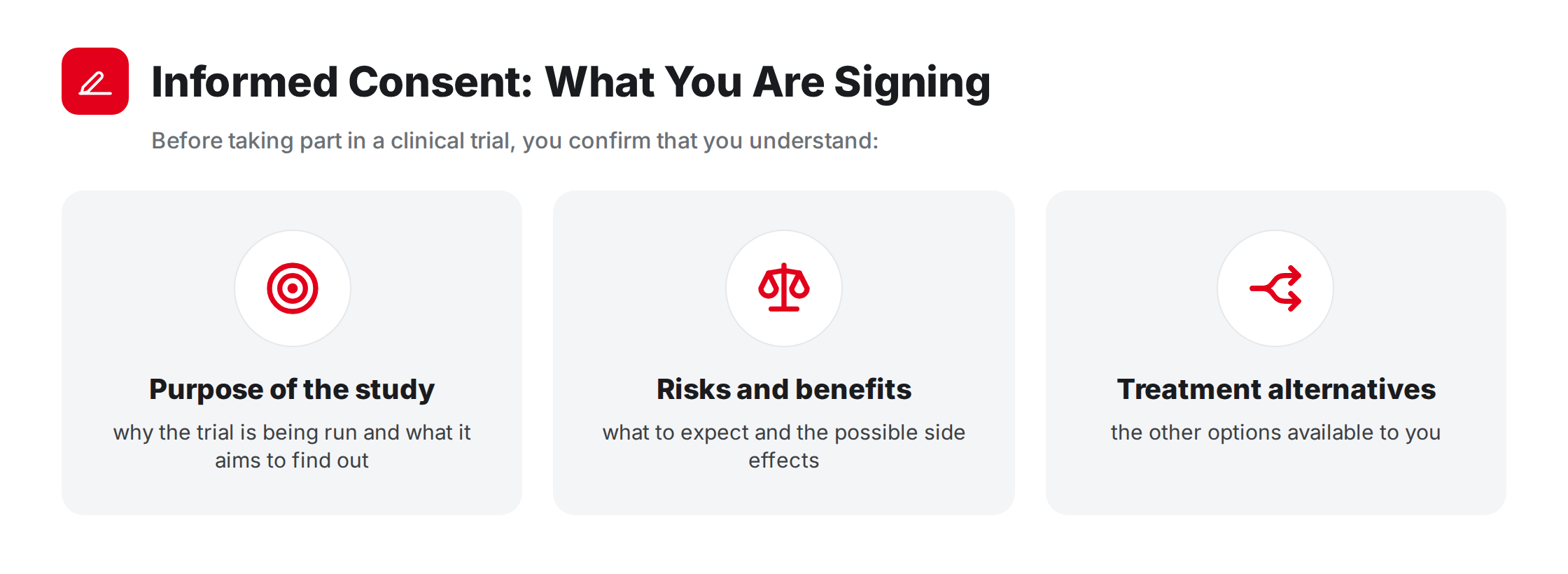
Before taking part, the patient receives a document describing:
- the aim of the trial;
- possible risks;
- potential benefits;
- alternative treatment options.
This is a key element of patient protection, far more than a formality.
What the patient should do
Take your time before signing. Read the document carefully, ask your doctor questions and make sure you understand:
- which procedures will be carried out;
- which side effects are possible;
- what happens if you decide to withdraw.
If anything is unclear, that is a reason to ask for clarification.
Risks and limitations
Despite strict oversight, clinical trials always involve uncertainty. A new method may prove effective, or it may not deliver the expected result. Participation may also require:
- frequent visits to the clinic;
- additional examinations;
- strict adherence to the protocol.
It is important to weigh the burden as well as the potential benefit. Sometimes standard treatment may be the more predictable option.
Can trial participation be combined with treatment in your home country?
For international patients, a particularly important question is how participation in a trial will fit with treatment already under way at home. In practice this is one of the most sensitive points, because a clinical protocol requires strict compliance, and parallel prescriptions, additional medicines or uncoordinated changes to a treatment regimen can affect both safety and the possibility of continued participation.
That is why patients should discuss coordination between the Swiss team and their doctor at home in advance. They need to know which medicines and procedures are permitted, which must be temporarily stopped, who makes decisions if their condition changes and how medical information will be exchanged between the two sides. The better this communication is organised, the lower the risk that the patient ends up between two treatment systems without a single clear plan.
Who pays for trial participation, and which costs may remain with the patient
One of the most practical questions, and one that patients often ask too late, is what exactly is covered by the trial and what is not. Taking part in a clinical trial does not always mean that the sponsor automatically covers every cost.
As a rule, the protocol covers the procedures, tests and visits directly related to the trial, but additional costs may remain with the patient. These may include travel, accommodation, some related examinations, translation of documents, logistics of personal support or treatment of conditions outside the scope of the protocol.
It is therefore important to gain a clear picture of the financial side before enrolment. Patients will find it useful to clarify in advance which costs are covered by the trial, who pays for emergency care in the event of complications, whether follow-up after participation ends is included, and whether travel or organisational expenses are reimbursed.
How to avoid mistakes when taking part in clinical trials
One of the most common mistakes is to see a clinical trial as a guaranteed chance of better treatment. In practice, a trial offers access to a method whose effectiveness and risks are still being studied, rather than a promise of results. That is why it is important for patients to keep their expectations realistic and to let hope rest on facts.
Another common mistake is agreeing to participate without understanding the details of the protocol. Some patients read the informed consent form superficially and do not clarify the frequency of visits, the scope of examinations, possible side effects or the conditions for leaving the trial. As a result, once enrolled, they face a burden they were not prepared for. The more complex the illness and the more emotional the situation, the more important it is to understand every stage rather than sign documents on trust.
A further mistake is withholding part of one’s medical information from the research team. Patients sometimes believe that leaving out a concurrent illness, previous therapy or adverse reactions will improve their chances of being enrolled. In reality, this can affect both safety and the integrity of the trial itself. Complete medical data is critically important here.
Patients also frequently underestimate the organisational side of participation. A trial may require frequent visits, strict adherence to a schedule, additional tests and constant contact with the clinic. Without assessing the logistics, time commitment and physical demands in advance, participation can prove far more difficult than expected.
Finally, a serious mistake is forgoing an independent second opinion. Even if a trial looks promising, it is worth discussing it with your treating doctor or another specialist who is not involved in the protocol. Such a conversation helps you understand whether participation is truly the best option in your situation, or whether standard treatment remains the more sensible choice.
The conclusion is simple: enter a clinical trial after a calm assessment of the benefits, risks, limitations and your own ability to see the whole journey through, rather than out of desperation or under the pressure of urgency.
What happens after the trial ends
One of the most underestimated questions is what happens once the trial ends, rather than how to get into it. This matters greatly to the patient, because participation in a clinical trial does not always mean that access to the therapy will automatically continue. Sometimes treatment stops when the protocol ends, sometimes the patient is moved to a standard regimen, and in some cases further monitoring or continued therapy is possible under separate trial rules.
That is why, even before signing the consent form, it is worth clarifying what will happen after participation ends. You need to know whether monitoring will continue, who will look after you from then on, whether you will receive final medical documentation and how the transition back to your treating doctor at home will be organised. If the trial involves travelling to Switzerland, it is especially important to establish in advance who is responsible for ongoing communication after you return home and how quickly you can obtain discharge summaries, test results and recommendations for your local medical team.
This question matters from a practical as well as a medical point of view. Patients need to be sure they will not find themselves in a situation where one course of treatment was started during the trial, yet the next steps remain unclear once the protocol ends. The better the “exit” from the trial is planned in advance, the safer and calmer the whole process.
In practice this means one simple thing: before you begin, ask about the plan for after the trial as well as about enrolment, risks and the monitoring procedure.
How to proceed
The best strategy is to act systematically:
- Understand your diagnosis and the stage of the disease clearly.
- Find out which trials are available in this field.
- Prepare your documents and submit them for assessment.
If you have already been offered a place in a trial, take your time with the decision. Compare it with your current treatment, discuss it with an independent doctor and only then decide.
Once participation has begun, it is important to follow all the requirements of the protocol and to stay in contact with the medical team.