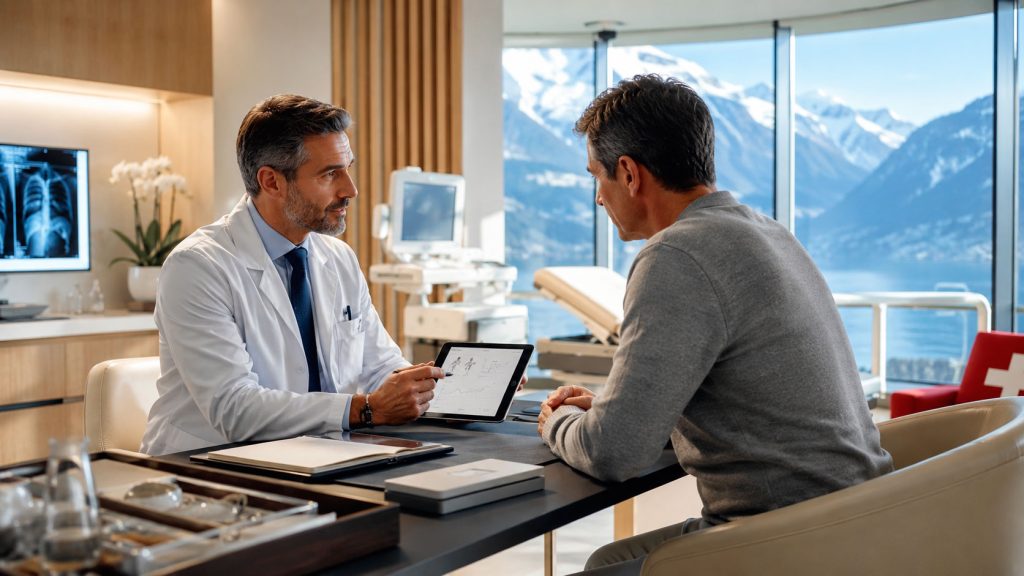
When someone considers treatment abroad, the first question usually concerns the doctors’ qualifications. A second question is asked less often, yet proves just as important: how will the doctors talk to me? Swiss medicine stands out for more than its technical standard. It has developed a culture in which the patient is a full participant in decision-making. This is a systemic feature, anchored in law and repeated in every consultation.
Informed consent as a genuine conversation
In most countries, informed consent comes down to signing a form before a procedure. In Switzerland it works differently.
The law on patients’ rights establishes the right to full information about the diagnosis, the available treatment options, the risks of each and the possible consequences of declining treatment. The doctor must provide this information and must also make sure the patient has understood it. This changes the nature of the consultation: it becomes a dialogue rather than a specialist’s monologue.
In practice, the patient comes for a competent explanation rather than a ready-made decision. The doctor sets out the options, describes the trade-offs and answers questions — and only then does the patient decide. This approach takes time, but it is precisely what builds trust: the person feels that nothing is being imposed on them.
The patient as co-author of the treatment plan
Shared decision-making is widely practised in Swiss medicine. Its essence is that neither doctor nor patient decides unilaterally. The doctor brings medical expertise; the patient brings knowledge of their own life, values and priorities.
This matters because many medical decisions have more than one right answer. Two treatment options may be equally sound from a medical point of view, yet one involves lengthy rehabilitation and the other a higher risk of recurrence. The choice depends on what matters more to the individual. A Swiss doctor leaves this choice to the patient.
For people coming for treatment from other countries, this is often a surprise. They are used to a model in which the doctor decides and the patient follows. Here things work differently, and this calls for a certain readiness to take part in one’s own treatment.
Transparency at every stage
In Swiss medicine, transparency is a working principle.

Patients have the right to full access to their medical records at any time. This includes test results, images, specialists’ reports and the treatment history. There are no requests through administration and no waiting for weeks: the documents belong to the patient.
Every prescription is explained: why this medicine, for how long, what to expect and which side effects are possible. The patient always knows why a particular treatment has been prescribed.
The attitude to second opinions deserves special mention. In Switzerland, consulting another specialist is the norm and a sign of good medicine rather than of mistrust. Many doctors recommend it themselves for serious diagnoses. The system treats a second opinion as an element of quality care, fully compatible with respect for the specialist.
A cultural and systemic foundation
What is described above stems from the system as a whole rather than from the personal qualities of individual doctors.
Swiss legislation regulates in detail the rights of patients and the duties of medical institutions to inform them. Failure to meet these standards has legal consequences, which creates a lasting incentive to uphold them at every level — from private clinic to university hospital.
Medical education in Switzerland places considerable emphasis on communication with patients. It is treated as part of professional competence rather than a soft skill added to clinical training. Medical students learn to explain complex matters in clear language, to address a patient’s anxiety and to conduct difficult conversations.
Finally, Switzerland is a multilingual and multicultural country. Doctors here are used to working with people of different backgrounds, expectations and communication styles. For international patients, this means they are very likely to meet a specialist who adapts the conversation to them.
What this means for an international patient
People who come to Switzerland for treatment often remark on the same thing: they are surprised by how much time the doctor spends explaining. This time is part of the treatment itself.
Trust in a doctor rests on more than reputation or the clinic’s equipment. It rests on whether the patient has understood what is happening to them, and whether they feel their view is taken into account. Swiss medicine creates the conditions for both.
For someone deciding on treatment abroad, this is an important factor — possibly as important as the clinic’s technical standard.
Practical questions: what to ask at the first consultation
The culture of informed consent works both ways: the doctor must explain, and the patient should be ready to ask. Here are questions worth asking at the first consultation, whatever the diagnosis and the doctor’s specialty.
About the diagnosis and situation:
- What is my diagnosis, and how certain is it at this stage?
- Which further examinations are needed, and why?
- What will happen if treatment does not start now?
About treatment options:
- What treatment options exist in my case?
- How do they differ in terms of risks, timing and likelihood of success?
- Is there an option you personally recommend, and why?
About the process and rehabilitation:
- What will the treatment look like, stage by stage?
- How long will recovery take?
- What restrictions will apply during rehabilitation?
About a second opinion:
- Would it make sense to consult another specialist in my case?
This list is a way to make full use of what the Swiss system offers — genuine participation in your own treatment — rather than a test of the doctor.
How CorSwiss can help
Organising treatment in Switzerland on your own is demanding: choosing a clinic, booking the right specialist, translating medical documents, arranging logistics. CorSwiss takes on these tasks — from the first consultation to discharge.
We provide consultations and organise examinations and treatment at leading Swiss clinics. If you are considering treatment in Switzerland and would like help with the first step, contact us.